AgentStatus x Sardine, a quick map of how we fit
Independent, distributed assurance for production AI agents, alongside Sardine's agentic risk platform.
AgentStatus is how teams prove behaviour in the wild: independent, distributed production assurance for AI agents, with continuous checks, gold-based expectations, and alerting, run from 2,500+ nodes across 70 countries. We sit alongside Sardine's KYC Onboarding, Sanctions Screening, Merchant Risk, and Disputes Agents. We don't replace them.
What we understand about Sardine
The agentic risk platform unifying fraud prevention, AML compliance, and real-time transaction monitoring.
Sardine is the agentic risk platform built for fraud prevention, AML compliance, and credit underwriting, with Device Intelligence, Behavior Biometrics, and Machine Learning at the foundation. The platform combines proprietary device and behavioral signals with cross-industry Consortium intelligence and a configurable Rules Engine to catch fraud patterns in real time, then layers AI Agents on top to automate the investigation work that used to take human analysts 30+ minutes per alert.
The agent suite includes the KYC Onboarding Agent (resolves edge cases like name mismatches and document verification), the Sanctions Screening Agent (automates alert triage and decisioning across configured rules), the Merchant Risk Agent, and the Disputes Agent. In February 2026, Sardine introduced user-scoped AI agent conversations that let investigators explore hypotheses with private-by-default research spaces while preserving shared visibility on alerts. Customers using the AI agents are seeing up to 4x ROI through automated onboarding and alert resolution.
Sardine is trusted by 300+ enterprise customers in 70+ countries including FIS, Ascensus, Deel, GoDaddy, X, and Modulr, with $1.3T+ in payments screened, 2.2B+ profiled devices, and 5.4B+ sessions processed. Backed by Andreessen Horowitz, Activant Capital, Visa, Experian, Moody's, FIS, Google Ventures, and Geodesic Capital, with $145M total raised including a $70M Series C. 130% YoY ARR growth in 2024.
What AgentStatus is
Continuous, controlled validate traffic against production agent surfaces.
AgentStatus runs continuous, controlled validate traffic against production and staging agent surfaces, with gold libraries, drift detection, and alerting for teams that need clear, repeatable evidence when things break or drift.
That includes multi-turn flows and multi-agent journeys when real customer paths span KYC onboarding, transaction monitoring, sanctions screening, and disputes, and it maps cleanly to governance and risk conversations when banks, fintechs, regulators, or auditors ask what ran, from where, and what changed.
For agents shaping decisions at $1.3T+ in screened payments, and operating under regimes like Nacha, OCC, FDIC, SEC, and BSA/AML, the cost of an undetected behaviour shift isn't a UX issue, it's a regulatory finding, a missed SAR, or a customer wrongly denied access.
Independent third-party validation is two separate jobs

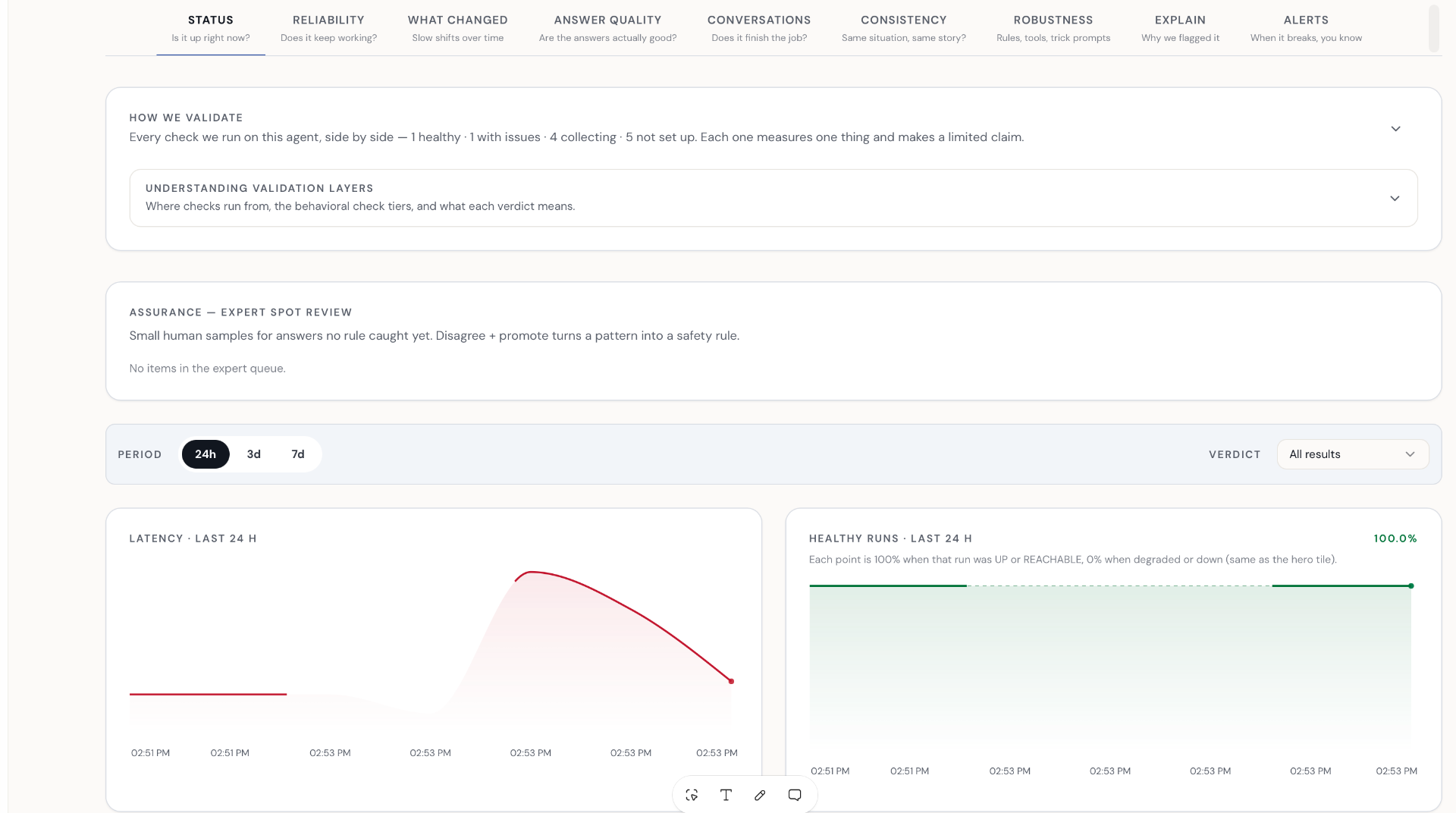
Reachability
Outcome
Can we talk to it?
Residential observers take the inbound path customers take — past CDN, WAF, and bot walls that treat datacenter synthetics differently. Monitoring asks: is it healthy right now? Reliability asks: does it keep working over time? “Up” means reachable from home networks, not from AWS.
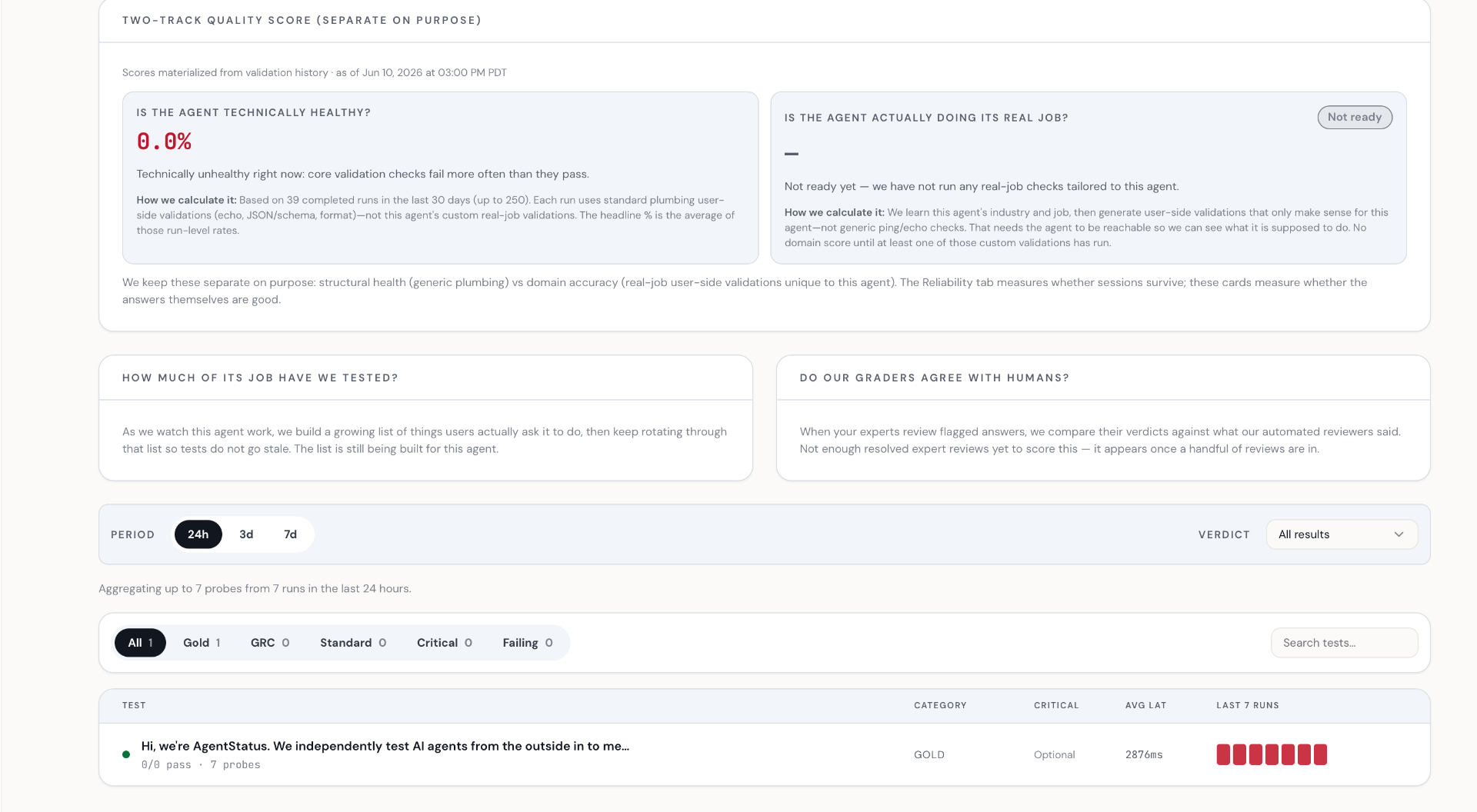
Outcome verification
Outcome
Did it do the right thing?
Reachable and wrong is still broken. Scenario — did it finish the job? Compositional — do the pieces hold together? Safety — must-not-say, policy, attack probes. Stability — same ask, same story? Scores: Consistency and Drift. Not prose matching. Optional sample review is corroboration only.
Where we fit
We sit beside the platform. We do not replace it.
Internal audit trails vs continuous evidence
Sardine's agents already publish full audit trails with human oversight, that's the right baseline for regulator-ready operations. AgentStatus answers a different question: as the KYC Onboarding Agent and Sanctions Screening Agent scale across FIS, Deel, GoDaddy, X, and the broader 300+ customer base, are they still operating the way the configured rules expect, on every alert, every day, against every new fraud pattern that emerges?
Eval-time accuracy vs production drift
Sardine's models are validated against billions of training sessions and 4,000+ engineered fraud features, that's the foundation. Distributed validate traffic catches the cases where, residential observers can't open the same door cloud checks do — or, once reached, a refreshed model drifts against contract checks and consistency probes before that compounds across a customer's alert queue. Multi-geo is inbound reachability, not decision localization by probe IP.
Global execution footprint
2,500+ nodes across 70 countries is the proof we are not 'synthetic from a single cloud region.' For Sardine's customers operating across 70+ countries, and for partners like Modulr, Visa, FIS, and Moody's flowing data through the platform, it matters that residential observers validate inbound reach from where users and transaction channels connect. Multi-geo is access and last-mile latency, not decision localization by probe IP.
Partner-friendly integration posture
We do not assume we can 'discover' Sardine customers the way some web-widget vendors can be scraped. Credential-based surfaces (sandbox API access, customer-approved monitoring, joint scenarios) are the right model, aligned with the SOC 2 / regulator-aware posture Sardine maintains across banks and fintechs.
The split
How the work divides
Your platform
- • Agentic risk platform
- • KYC / Sanctions / Disputes / Merchant Risk Agents
- • Device Intelligence and Behavior Biometrics
- • Rules Engine + 4,000+ fraud features
- • Consortium of 2.2B+ profiled devices
Outcome
System of record
Dashboards, exports, lifecycle tools, and orchestration remain yours. We do not replace that surface.
AgentStatus
- • Continuous validate traffic
- • Gold libraries and drift detection
- • Multi-turn / multi-agent journeys
- • Real-network execution evidence
- • 2,500+ nodes across 70 countries
Outcome
User-side layer
Reachability (Monitoring / Reliability) from residential networks, then outcome verification once reached — Scenario, Compositional, Safety, Stability; Consistency and Drift scores. Not prose matching.
Proof of scale
Auditable scale metrics
In about two months, we have executed on the order of 18 million validate runs across the network. We also maintain on the order of 6,000 agent records in our system, meaning rows and configurations we track, including evaluation and pipeline agents, not "6,000 paying customers."
If helpful, we can share stricter production-only definitions under NDA.
What we are not claiming
We are an independent layer that runs alongside your stack.
We are not a replacement for the KYC Onboarding Agent, the Sanctions Screening Agent, the Merchant Risk Agent, the Disputes Agent, the Rules Engine, the Consortium, or the Device Intelligence and Behavior Biometrics signals Sardine has built. We are an independent layer that can coexist with them, and, where useful, help banks and fintechs correlate user-side validate outcomes with inside-out agent decisions, so risk leaders, compliance officers, and CISOs have continuous evidence the deployed agents are still behaving the way the rules and regulators require.
What we'd like from this conversation
These three asks would move a pilot forward.
Validate the fit
As the KYC Onboarding, Sanctions, Disputes, and Merchant Risk Agents scale across FIS, Deel, GoDaddy, X, and the broader 300+ customer base, where do customers want independent assurance, and where does Sardine prefer everything native to the platform?
A practical next step
A sandbox surface we can validate with gold prompts representative of a fraud and compliance workflow (KYC onboarding edge cases, sanctions alert triage, dispute resolution, merchant risk decisioning), so Sardine's agents and AgentStatus drift detection tell one story together.
Partner path
If there is a partner path, we'd like to understand supported integration patterns for banks and fintechs operating across the US, EMEA, LATAM, and APAC, particularly given the March 2026 Nacha mandate for real-time ACH fraud monitoring and the broader regulatory shift toward continuous, defensible operational evidence.
Sardine helps banks and fintechs build and operate the agentic risk platform that stops fraud, automates compliance, and unifies risk data across teams.
AgentStatus helps those same teams prove, continuously, that the deployed agents behave the way regulators, auditors, and customers require, globally, with evidence that holds up under scrutiny.
Contact·dulra@carmel.so·roman@carmel.so
Metrics are stated with explicit definitions: validate runs are scheduled executions over approximately two months; agent records are database rows, not revenue customers. Public Sardine references above reflect public product pages, the $70M Series C announcement (Activant Capital lead), the AI Agents launch, the February 2026 user-scoped agents update, customer disclosures (FIS, Ascensus, Deel, GoDaddy, X, Modulr), and the Nacha 2026 mandate guidance as of the date of this note.