AgentStatus × Roots Automation, a quick map of how we fit
Independent verification for Roots' insurance-trained agents.
We do two jobs: reachability from residential networks (past CDN/WAF), then reliability once reached — gold/contract and consistency checks, across the channels each platform supports, from 2,500+ nodes across 70 countries. We sit alongside Roots' AI agent library and multi-system integrations. We don't replace them.
What we understand about Roots
Insurance-trained AI agents for claims and underwriting.
Roots is the AI agent platform built for insurance, purpose-built agents for claims and underwriting, with insurance brains embedded into the platform itself. The agent library covers the lifecycle: submissions intake and triage, loss history access for underwriters, premium audit at 98%+ accuracy, FNOL/FROI automation, and policy management.
Roots positions itself as a transparent, ethical alternative to BPOs and to general-purpose LLMs, with multi-system process automation that integrates into the tools insurance teams already use daily, and a Trust Center built around the data security expectations of carrier customers.
What AgentStatus is
We measure whether users can reach the agent, then whether it still passes its checks.
Reachability. Controlled validations from 2,500+ residential devices across 70 countries measure whether users can open the agent the way they do — past CDN, WAF, and bot walls. Multi-geo is observer vantage for access and last-mile latency — not answer localization by probe IP, and not agent tool egress.
Outcome verification. Once reachable, we verify outcomes: Scenario (did it finish the job?), Compositional (do the pieces hold together?), Safety (must-not-say / policy / attacks), Stability (same ask, same story?). Consistency and Drift track what changed. Job anchors and side-effects where they exist — not prose matching. Optional sample review is corroboration only; stably wrong still needs a domain expert.
That includes multi-turn conversations and multi-agent journeys when customer paths span tools, escalations, and handoffs. It supports governance and risk conversations when stakeholders ask what was tested, from where, and what changed.
Independent third-party validation is two separate jobs

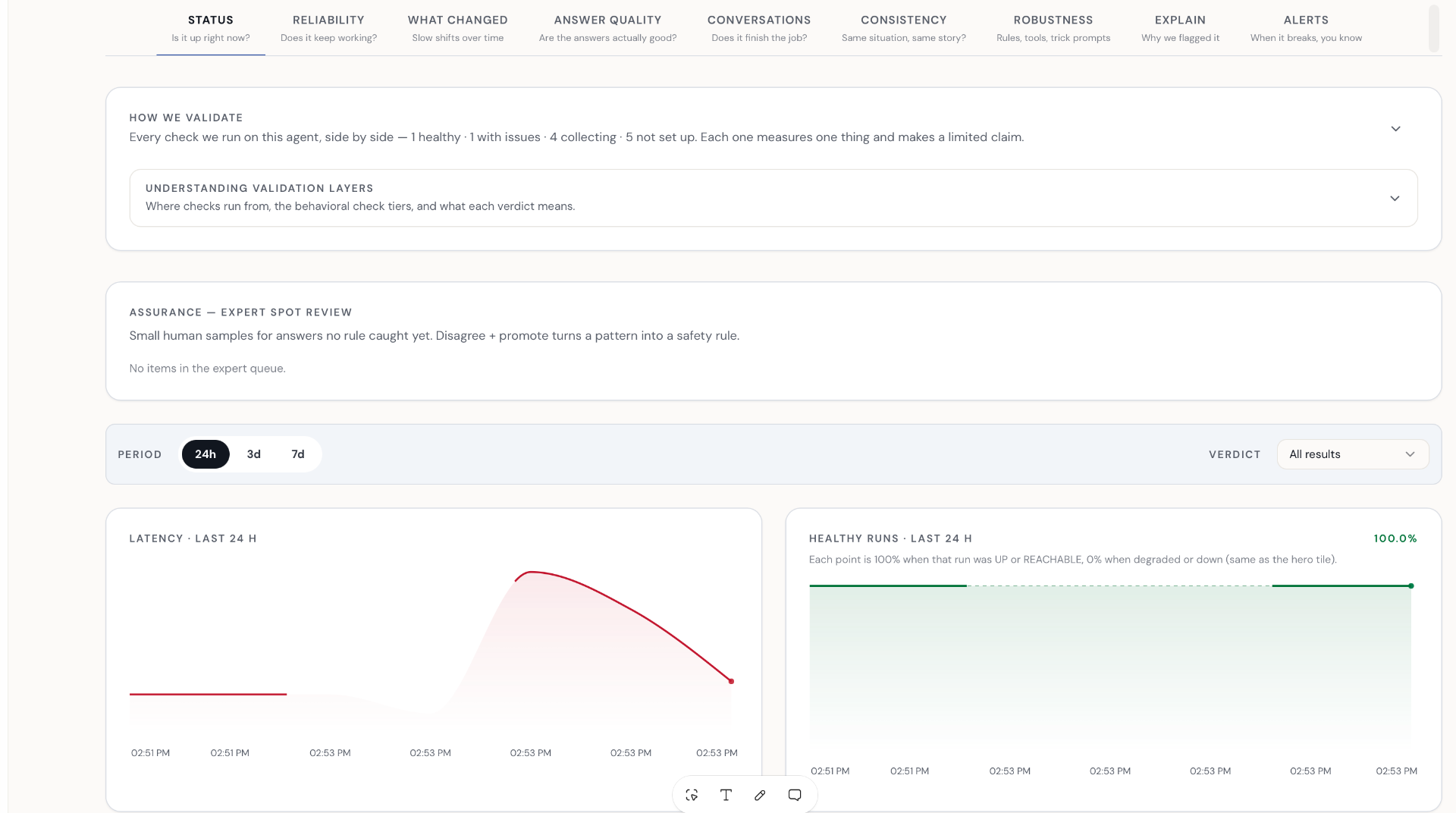
Reachability
Outcome
Can we talk to it?
Residential observers take the inbound path customers take — past CDN, WAF, and bot walls that treat datacenter synthetics differently. Monitoring asks: is it healthy right now? Reliability asks: does it keep working over time? “Up” means reachable from home networks, not from AWS.
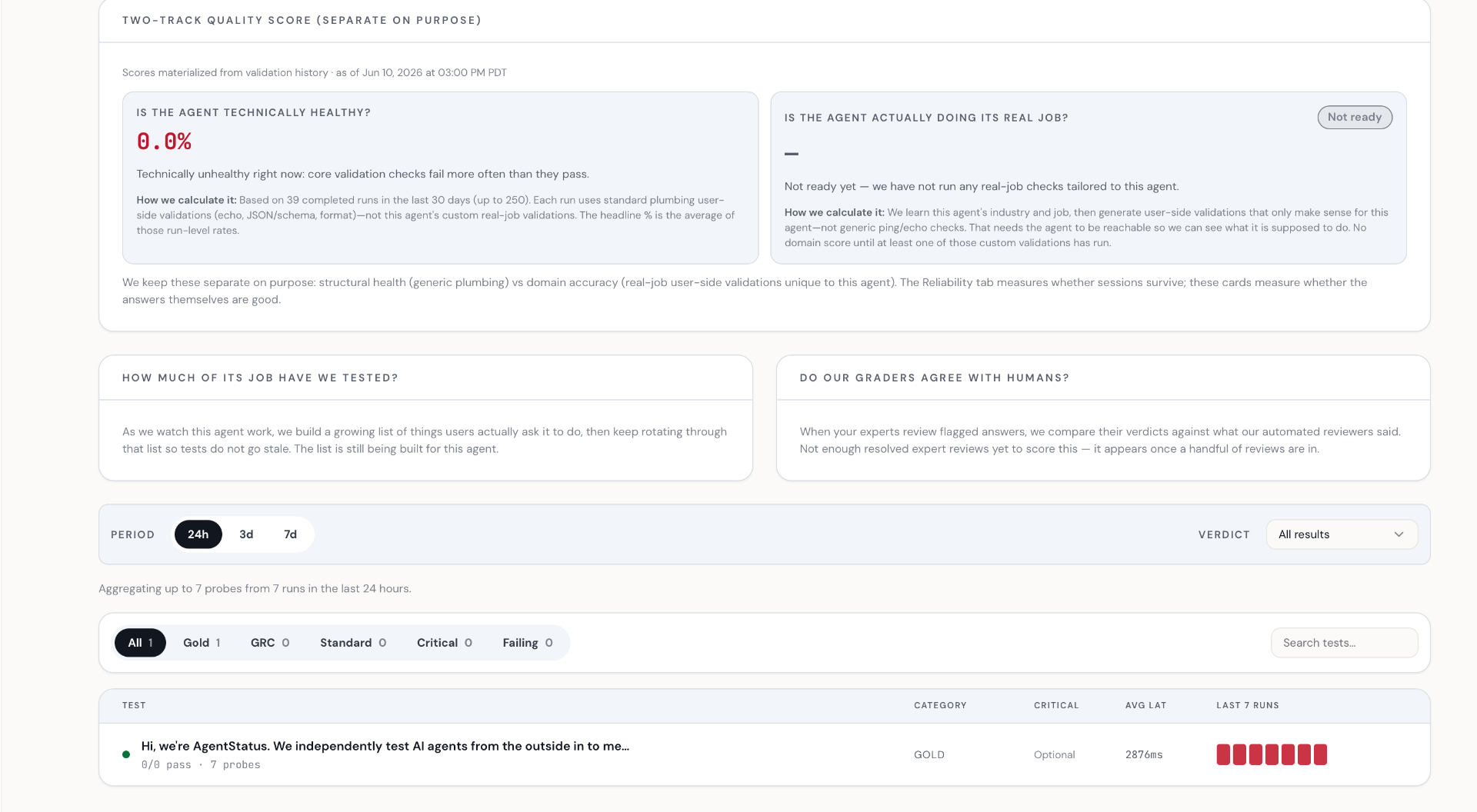
Outcome verification
Outcome
Did it do the right thing?
Reachable and wrong is still broken. Scenario — did it finish the job? Compositional — do the pieces hold together? Safety — must-not-say, policy, attack probes. Stability — same ask, same story? Scores: Consistency and Drift. Not prose matching. Optional sample review is corroboration only.
Where we fit
We sit beside the platform. We do not replace it.
Insurance-trained agents vs production drift
Roots ships agents trained on insurance, that's the foundation. AgentStatus answers the next-layer question: what did the deployed agent actually do for a user-like validate today, given a specific submission, claim type, or geography, and did the answer drift from what the expected answer says it should be?
Premium audit accuracy vs ongoing accuracy
A 98%+ accuracy figure is a strong inside-out signal at evaluation time. Distributed validate traffic catches the cases where that accuracy starts slipping in production, before a renewal cycle is priced wrong or a claim is mis-triaged at FNOL.
Global execution footprint
2,500+ nodes across 70 countries is the proof we are not 'synthetic from a single cloud region.' It matters for carriers operating across multiple geographies and for access or path failures that only reproduce from specific residential networks or partner edges — distinct from answer-quality checks once reached.
Partner-friendly integration posture
We do not assume we can 'discover' Roots customers the way some web-widget vendors can be scraped. Credential-based surfaces (agent endpoints, sandbox environments, customer-approved monitoring) are the right model, aligned with the security posture Roots already maintains for its carrier customers.
The split
How the work divides
Your platform
- • Insurance-trained agents
- • Claims & underwriting library
- • Multi-system automation
- • Premium audit accuracy
- • Trust Center & data security
Outcome
System of record
Dashboards, exports, lifecycle tools, and orchestration remain yours. We do not replace that surface.
AgentStatus
- • Continuous validate traffic
- • Expected-answer checks & drift detection
- • Multi-turn / multi-agent journeys
- • Real-network execution evidence
- • 2,500+ nodes across 70 countries
Outcome
User-side layer
Reachability (Monitoring / Reliability) from residential networks, then outcome verification once reached — Scenario, Compositional, Safety, Stability; Consistency and Drift scores. Not prose matching.
Proof of scale
Auditable scale metrics
In about two months, we have executed on the order of 18 million validate runs across the network. We also maintain on the order of 6,000 agent records in our system, meaning rows/configurations we track, including evaluation and pipeline agents, not "6,000 paying customers."
If helpful, we can share stricter production-only definitions under NDA.
What we are not claiming
We are an independent layer that runs alongside your stack.
We are not a replacement for Roots' agent library, insurance training, or multi-system integrations. We are an independent layer that can coexist with them, and, where useful, help carriers correlate user-side validate outcomes with inside-out agent performance, so claims and underwriting leaders have continuous evidence the deployed agent is still behaving the way regulators and customers expect.
What we'd like from this conversation
These three asks would move a pilot forward.
A 2-week sandbox pilot
A sandbox agent (FNOL triage, premium audit, or underwriting submission), a set of agreed scenarios with expected answers, and a 2-week evaluation window. No production traffic, no policyholder data. At the end you get a written report of what we tested, what passed, and what drifted.
Security and procurement posture
How AgentStatus should connect in a way that satisfies carrier security reviews. Data handling, least privilege, audit evidence, and clear test-traffic boundaries aligned with Roots' Trust Center posture.
Where independent proof is most useful
Whether the right starting point is Roots-internal QA, a joint carrier scenario where the buyer operates under regulatory and audit requirements (primary, P&C, life), or both.
Roots helps carriers build and operate AI agents trained on insurance from day one.
AgentStatus helps those same carriers prove, continuously, that those agents behave the way regulators, auditors, and policyholders require, globally, with evidence that holds up under scrutiny.
Contact·dulra@carmel.so·roman@carmel.so
Metrics are stated with explicit definitions: validate runs are scheduled executions over ~two months; agent records are database rows, not revenue customers. Public Roots Automation references above reflect Roots' public product pages, agent library, and Trust Center documentation as of the date of this note.