AgentStatus × Platform Partners
User-side monitoring for the AI you build, and the customer deployments running on it.
CCaaS and UCaaS platforms are shipping agentic AI fast. Platform monitoring tells you the system is up. Your customers' CISOs want different evidence — can users reach the agent from home networks, and once they can, do gold/contract and consistency checks still hold? AgentStatus is the user-side layer for both questions, with clear limits on each.
Independent third-party validation is two separate jobs

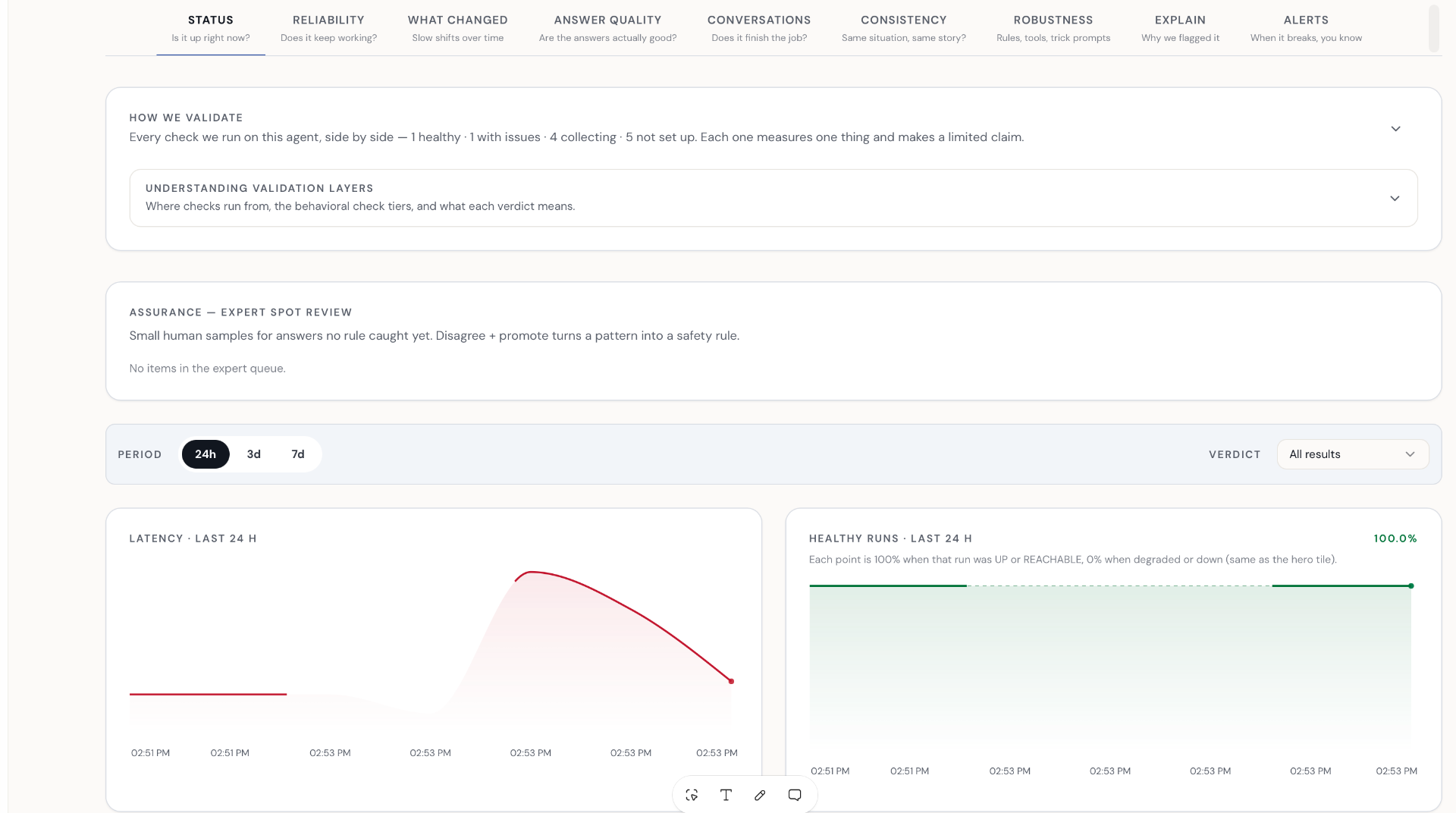
Reachability
Outcome
Can we talk to it?
Residential observers take the inbound path customers take — past CDN, WAF, and bot walls that treat datacenter synthetics differently. Monitoring asks: is it healthy right now? Reliability asks: does it keep working over time? “Up” means reachable from home networks, not from AWS.
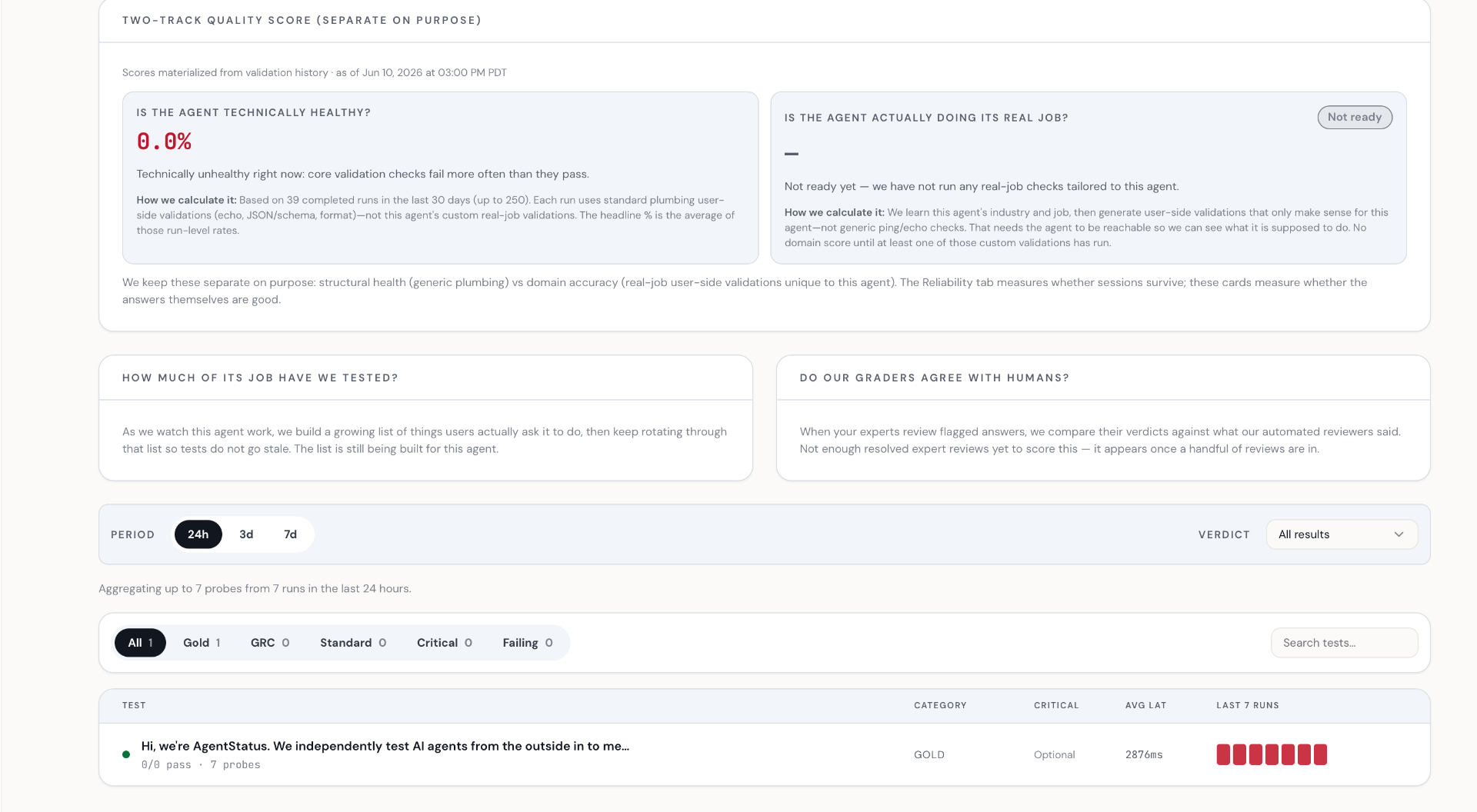
Outcome verification
Outcome
Did it do the right thing?
Reachable and wrong is still broken. Scenario — did it finish the job? Compositional — do the pieces hold together? Safety — must-not-say, policy, attack probes. Stability — same ask, same story? Scores: Consistency and Drift. Not prose matching. Optional sample review is corroboration only.
What we do
AgentStatus does two jobs from outside the platform.
We send realistic customer-style questions to your AI agents from real consumer devices in 70 countries. We log what comes back. We compare the responses to what a working agent should say - not just "did it respond?" but "did it respond correctly for the business it's serving?" We retain the evidence so it stands up in front of an auditor.
The result is something internal monitoring architecturally can't produce: an independent record of how your AI actually behaves in real users' hands, week after week.
Two ways in
There are two ways AgentStatus can show up for your platform.
Use AgentStatus directly on the AI products you ship.
The AI products you ship are your competitive position. User-side evidence tells your team how they behave in customer hands — across regions, channels, and capabilities. Catch regressions, prove reliability, back the enterprise sales motion.
Outcome
Your own agents get a user-side record.
Reachability from residential networks, then gold and consistency checks once reached — evidence internal monitoring cannot produce alone.
Offer AgentStatus to customers who deploy agents on your platform.
Your customers deploy agents on your platform. Their CISOs and procurement teams want independent evidence those agents work. AgentStatus surfaces in your marketplace as the reliability layer — co-sell, listing, revenue share.
Outcome
Customers inherit a reliability layer they can audit.
The differentiator your enterprise pitch leans on when buyers ask whether the agent actually works in the field.
Most platforms running both their own AI and customer deployments eventually want both.
What we find
User-side monitoring typically surfaces failures platforms miss from the inside.
The same patterns show up across the platforms we've monitored:
Agents that are technically up but behaviorally adrift.
They respond. The transport is fine. But the answers are generic, ungrounded, or off-topic for the business they're meant to serve. Internal "is it responding?" checks pass. The customer experience tells a different story.
Per-tenant variance hidden inside aggregate platform health.
Two of your customers running the same crew template can be 20 points apart on reliability, week after week. Platform-level monitoring averages it out. User-side surfaces it tenant by tenant.
Region-specific failures invisible to centralized telemetry.
Agents pass internal evals and cloud-region uptime checks but stay unreachable from specific residential ISPs in regions where your customers actually live — an access gap, not a different answer after HTTP 200.
Concentrated failure modes hidden in broad pass rates.
An 82% pass rate looks fine until you discover 80% of the failures are concentrated on one specific user intent - turning a "broad reliability problem" into a one-line fix.
Why this fits
This matters for platforms because their customers inherit the failure modes.
Your customers' CISOs and procurement teams are getting harder. Self-reported platform metrics don't pass enterprise scrutiny in regulated verticals anymore. Independent third-party user-side evidence is what gets agents into production - and keeps them there.
Bringing AgentStatus into your alliance program means your enterprise pitch includes an answer to "how do we verify the agents are actually working?" Most platforms don't have one. That's the differentiator.
The ask
Here is the concrete next step we are proposing.
A two-week structured pilot. Direct on your AI infrastructure, ISV-shaped on three to five customer deployments, or both. We align scope with your team upfront. Weekly reports. Honest finding at the end: did user-side surface things your internal monitoring didn't?
If yes, the natural shape depends on which motion landed: direct contract, formal ISV partnership with revenue share and co-sell, or both.
Your platform runs AI. Your customers run AI on your platform. We're the user-side layer for both.
We'd love to hop on a call and figure out where AgentStatus fits - direct, ISV, or both.
Contact·dulra@carmel.so·roman@carmel.so
AgentStatus is independent user-side production monitoring for AI agents. Validations target publicly-reachable customer-visible agent surfaces with conservative rate limits and customer approval. Findings cited above are representative patterns from monitoring on multi-tenant agent fleets, anonymized.