AgentStatus × Nextiva
User-side monitoring for Nextiva's AI infrastructure and the customer deployments running on it.
We ran a short-period validation sweep across three Nextiva-powered customer agents to ground the conversation in real data. Two findings worth flagging, plus a proposal to extend.
What we ran
Here is what we already ran against this surface.
We sent realistic customer-style questions to three Nextiva-powered customer-facing agents from real consumer devices across the US. Every validation asked the agent something it should know how to answer in its business domain - logistics questions to a logistics agent, real estate questions to a real estate agent, and so on.
310 total validations across three anonymized tenants over a short period.
Independent third-party validation is two separate jobs

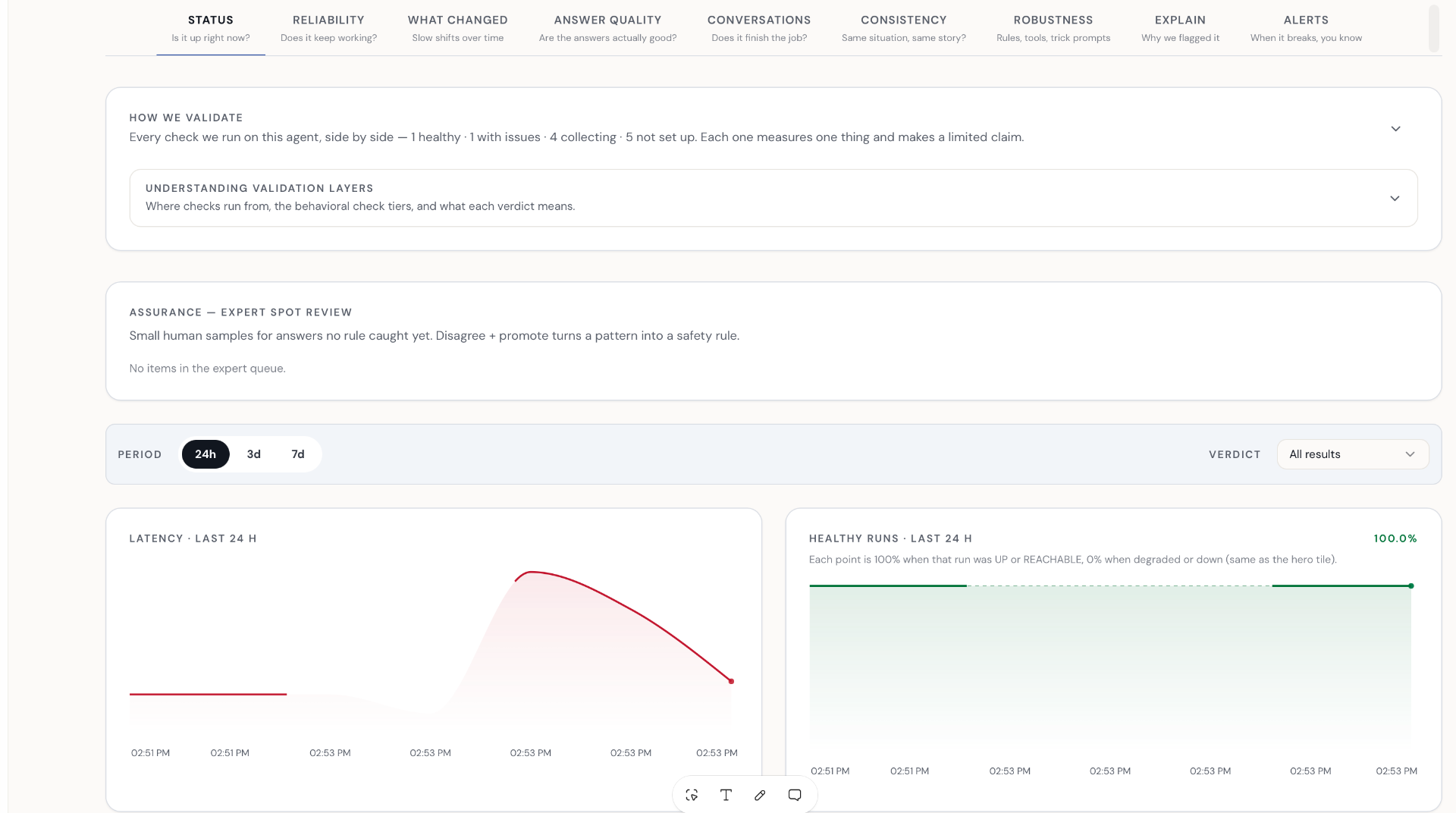
Reachability
Outcome
Can we talk to it?
Residential observers take the inbound path customers take — past CDN, WAF, and bot walls that treat datacenter synthetics differently. Monitoring asks: is it healthy right now? Reliability asks: does it keep working over time? “Up” means reachable from home networks, not from AWS.
Outcome verification
Outcome
Did it do the right thing?
Reachable and wrong is still broken. Scenario — did it finish the job? Compositional — do the pieces hold together? Safety — must-not-say, policy, attack probes. Stability — same ask, same story? Scores: Consistency and Drift. Not prose matching. Optional sample review is corroboration only.
Finding 1
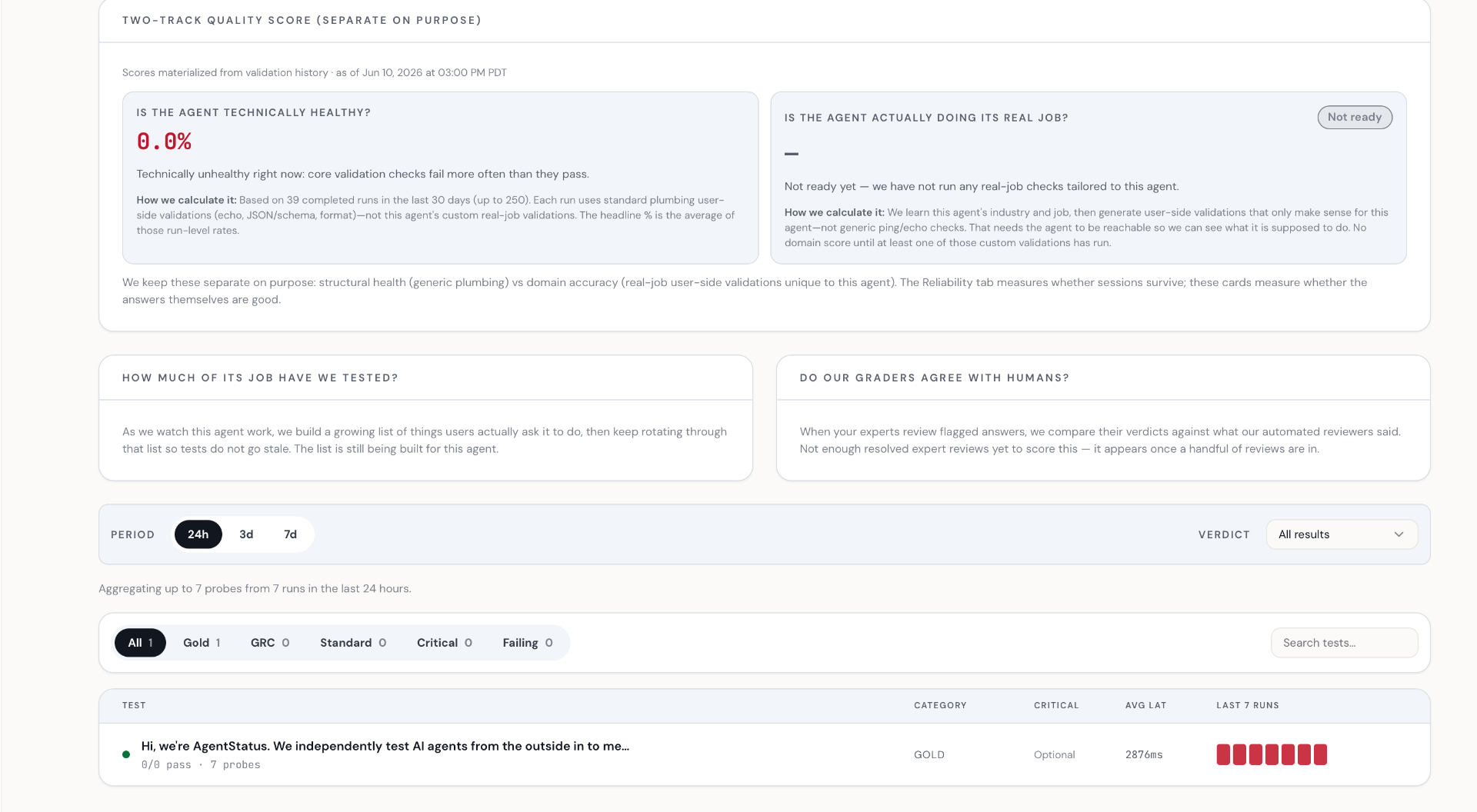
The agents are technically working. They're not doing their actual job.
The headline number is 51% of validations came back degraded. But the more important story is what kind of degradation.
| Tenant | Vertical | Validations | Worked correctly | Did the job well |
|---|---|---|---|---|
| Tenant A | Logistics | 99 | 37% | 0 / 28 |
| Tenant B | Nonprofit | 118 | 53% | 0 / 48 |
| Tenant C | Real estate | 93 | 57% | 0 / 24 |
The "did the job well" column is the one that matters.
When we asked these agents domain-specific questions - questions that an agent built for that business should be able to handle - zero out of 100 responses passed. Every single one. Across all three tenants. Across all three verticals.
The agents are responding. The transport layer is fine. The latency is fine. But the answers are generic, ungrounded, or off-topic for the business they're meant to serve. A logistics agent giving non-logistics answers to logistics questions. A real estate agent giving non-real-estate answers to real estate questions.
This is the failure mode platform-level monitoring doesn't catch. Internal uptime checks look at "did the agent respond?" User-side checks look at "did the agent respond correctly for its domain?" An agent can be 100% up and 0% useful at the same time.
Finding 2
Same platform, very different results per tenant.
Tenant A is degraded on 63% of validations. Tenant C is degraded on 43% of validations. Same platform, same short period, same kind of validations - but a 20-point spread in baseline reliability.
That spread is invisible from inside the platform, because platform health looks at the platform as a whole. It only surfaces when you compare tenants head-to-head from outside, which is what AgentStatus does by default.
For enterprise sales conversations, this matters - it's the question Nextiva's prospects' CISOs will ask: "how do we know our deployment will perform like Tenant C and not like Tenant A?" User-side evidence is the answer.
Anonymized tenant names available to Nextiva under mutual confidentiality.
Two ways in
There are two ways AgentStatus can show up for Nextiva.
Use AgentStatus directly on NextivaOne and Nextiva AI Agent.
Nextiva builds and ships NextivaOne and Nextiva AI Agent. User-side evidence on those products tells your team how they actually behave in customer hands — residential reachability across regions, plus gold/contract and consistency checks once reached — beyond what internal QA can simulate.
Outcome
Your own products get a user-side record.
Reach first, then reliability — evidence that stands up when enterprise buyers ask whether the agent works in the field.
Offer AgentStatus to customers who deploy agents on Nextiva.
Nextiva's customers deploy agents on the platform. Their CISOs and procurement teams want independent evidence those agents are doing the right thing. AgentStatus surfaces in the alliance program as the reliability layer — co-sell, marketplace listing, revenue share.
Outcome
Tenants inherit a reliability layer they can audit.
The answer to the CISO question: how do we know our deployment will perform like the best tenant, not the worst?
Most enterprise CCaaS deployments will eventually want both.
Honest framing
Here is what this proposal is, and what it is not.
This is a short-period snapshot with enough volume to make the findings real, not anecdotal.
This isn't a long-term trend study. We paused the validations after the window pending Nextiva's input on scope - the right next step is a longer pilot with Nextiva's product team confirming which domain questions are fair validations for each tenant's vertical.
A 2-week extension would tell us whether the domain-accuracy issue is structural (the agents really aren't grounded in their verticals) or methodological (our domain questions need refinement against how Nextiva defines correctness). Either answer is useful.
The ask
Here is the concrete next step we are proposing.
A two-week pilot. Direct on Nextiva's AI infrastructure, ISV-shaped on three to five customer tenants, or both. We align scope with your product team upfront. Weekly reports. Honest finding at the end.
Three tenants. A short period. Two findings.
We'd love to hop on a call and walk through what two weeks looks like - direct, ISV, or both.
Contact·dulra@carmel.so·roman@carmel.so
A short-window study concluding May 2026, on publicly-reachable Nextiva-powered customer agent chat surfaces. Validations ran at conservative rate limits (15-min intervals) with no auth bypass; no tenant data collected beyond verdict metadata, latency aggregates, gold-prompt outcomes, and short previews. Domain accuracy checks use gold prompts grounded in each agent's actual business context, scored against expected domain terms. Tenant names anonymized; available to Nextiva under mutual confidentiality. AgentStatus is independent user-side production monitoring for AI agents and is not affiliated with Nextiva.