AgentStatus x Legora, a quick map of how we fit
Independent, distributed assurance for production AI agents, alongside Legora's collaborative AI for legal and the Walter agent suite.
AgentStatus is how teams prove behaviour in the wild: independent, distributed production assurance for AI agents, with continuous checks, gold-based expectations, and alerting, run from 2,500+ nodes across 70 countries. We sit alongside Legora's collaborative AI workspace and the Walter AI agents now deployed into Word and Outlook. We don't replace them.
What we understand about Legora
The collaborative AI powering lawyers to review and research faster, draft smarter, and advise with precision.
Legora is the collaborative AI platform built for legal teams, adapting to the way lawyers work and unlocking team and machine collaboration at scale across review, research, drafting, and advisory work. The platform brings AI into legal workflows in a way that complements lawyer judgment, strategy, and creativity rather than replacing them, helping firms remove repetitive tasks and streamline complex workflows so legal teams spend less time on admin and more time practising law.
In March 2026, Legora announced the acquisition of Walter, the Canadian legal technology startup whose AI agents assist lawyers directly inside Microsoft Word and Outlook, automating drafting and document review where lawyers actually work. The acquisition followed a $550M funding round, giving Legora the capital to expand the platform and pursue further acquisitions.
Legora is ISO 42001 certified (the AI governance standard), ISO 27001 certified (information security), and operates under GDPR with the technical team in Sweden. It also meets SOC 2 requirements. Customers include BAHR (Norway), with deployments scaling across top-tier legal teams. Built on Anthropic models.
What AgentStatus is
Continuous, controlled validate traffic against production agent surfaces.
AgentStatus runs continuous, controlled validate traffic against production and staging agent surfaces, with gold libraries, drift detection, and alerting for teams that need clear, repeatable evidence when things break or drift.
That includes multi-turn flows and multi-agent journeys when real lawyer paths span review, research, drafting, and advisory work, and it maps cleanly to governance and risk conversations when law firms, regulators, or clients ask what ran, from where, and what changed.
For agents helping lawyers draft documents, review contracts, and conduct legal research, the cost of an undetected behaviour shift isn't a UX issue, it's a misadvised client, a missed clause, or a regulatory breach.
Independent third-party validation is two separate jobs

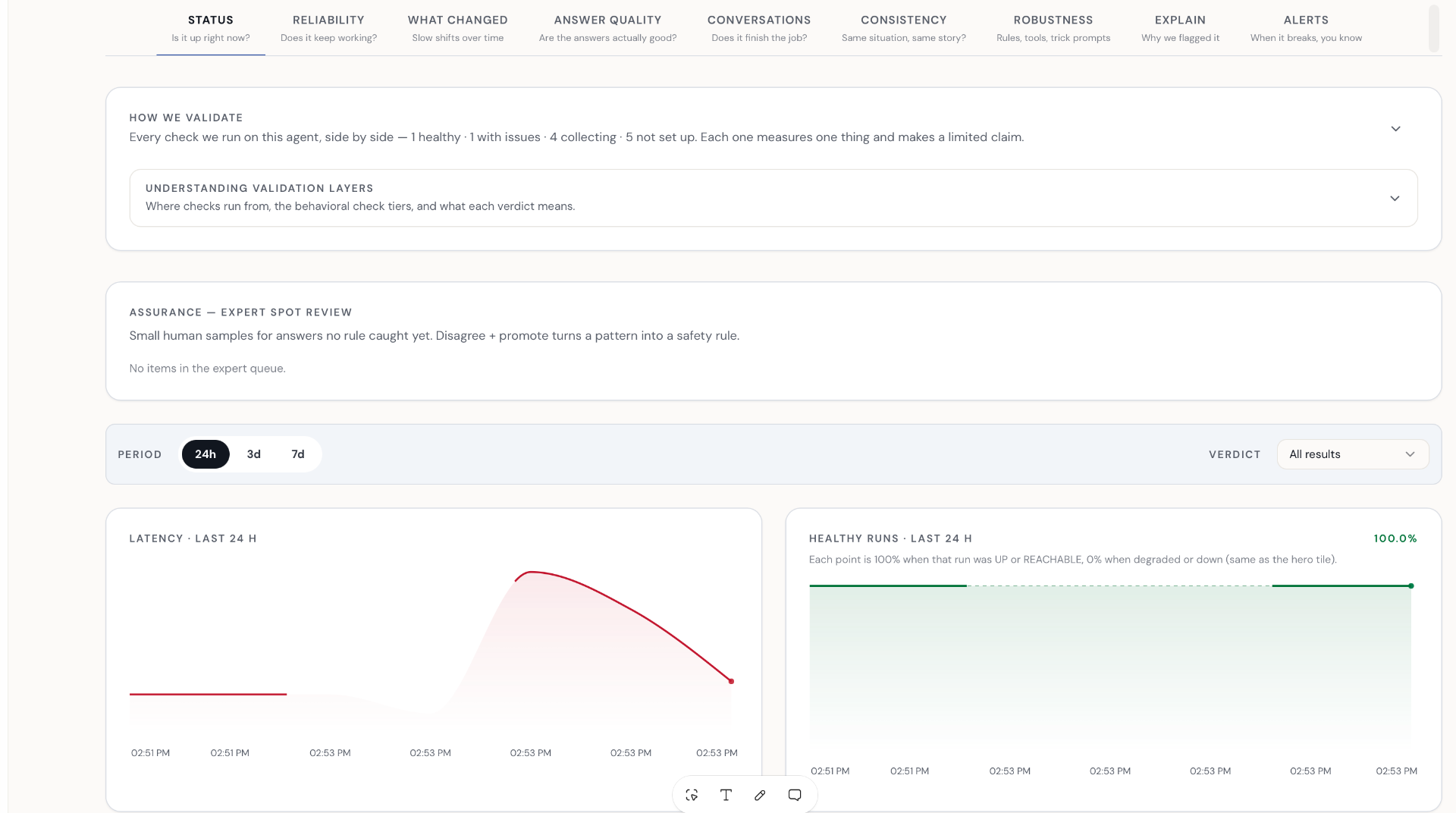
Reachability
Outcome
Can we talk to it?
Residential observers take the inbound path customers take — past CDN, WAF, and bot walls that treat datacenter synthetics differently. Monitoring asks: is it healthy right now? Reliability asks: does it keep working over time? “Up” means reachable from home networks, not from AWS.
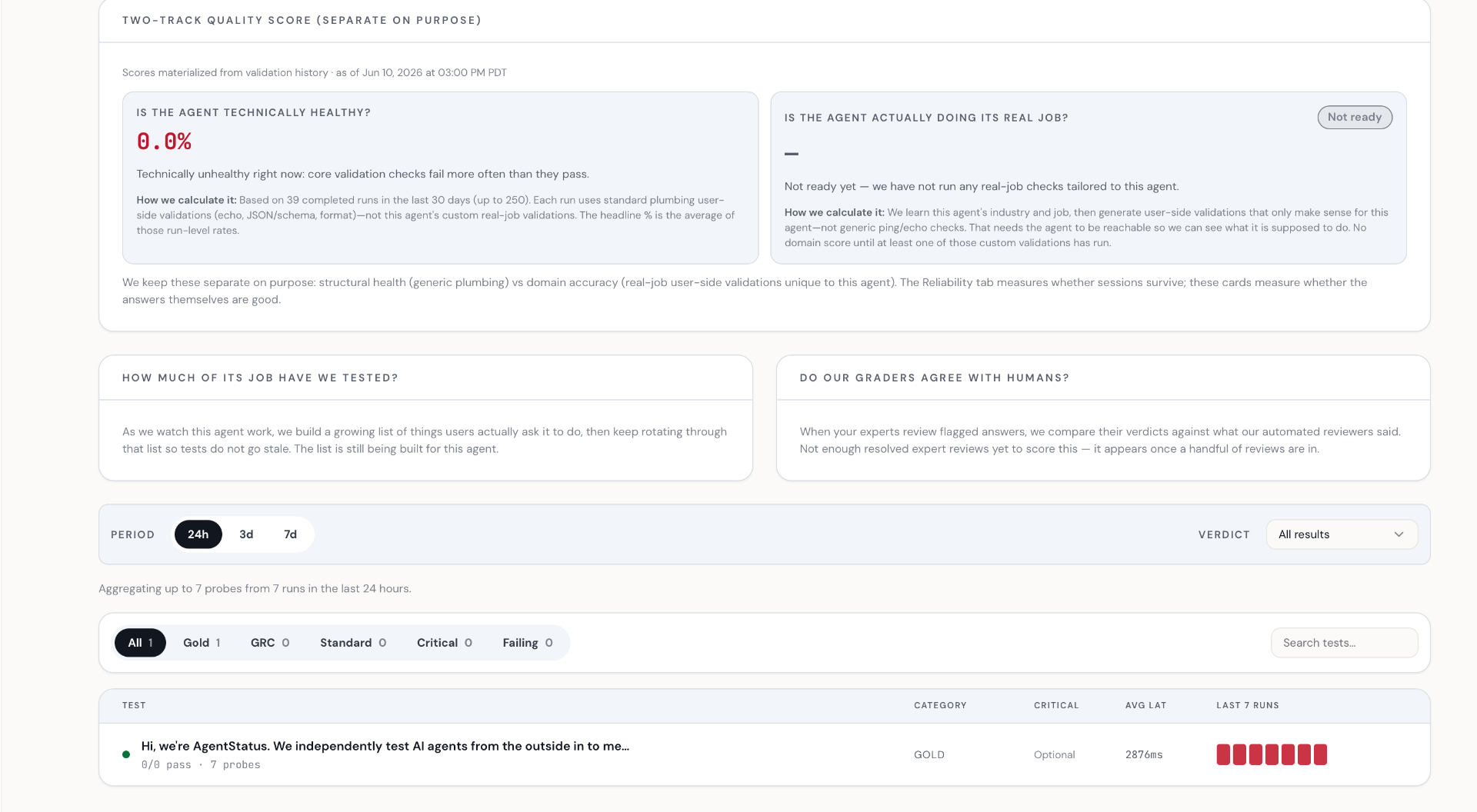
Outcome verification
Outcome
Did it do the right thing?
Reachable and wrong is still broken. Scenario — did it finish the job? Compositional — do the pieces hold together? Safety — must-not-say, policy, attack probes. Stability — same ask, same story? Scores: Consistency and Drift. Not prose matching. Optional sample review is corroboration only.
Where we fit
We sit beside the platform. We do not replace it.
ISO 42001 governance vs continuous evidence
Legora's ISO 42001 certification establishes the governance framework for how the AI is built and run, that's the foundation. AgentStatus answers a different question: as Legora and Walter scale across BAHR and the broader top-tier customer base, are the deployed agents still operating the way the framework expects, on every document, every day, against every clause type the lawyer encounters?
Eval-time correctness vs production drift
Legora's models are validated at training and deployment, that's the right baseline for a regulated profession. Distributed validate traffic catches the cases where the same drafting prompt, on a different document, against a refreshed model, fails gold/contract or consistency checks — before that drift reaches a partner-level review or, worse, a client.
Global execution footprint
2,500+ nodes across 70 countries is the proof we are not 'synthetic from a single cloud region.' For Legora's customers operating across Sweden, Norway, the broader Nordics, EMEA, and increasingly globally, and for Walter's deployment inside Microsoft 365 across multiple jurisdictions, it matters that residential observers validate inbound reach from where lawyers connect to those workflows. Multi-geo is access and last-mile latency, not answer localization by probe IP.
Partner-friendly integration posture
We do not assume we can 'discover' Legora customers the way some web-widget vendors can be scraped. Credential-based surfaces (sandbox API access, customer-approved monitoring, joint scenarios) are the right model, aligned with the ISO 42001 / ISO 27001 / SOC 2 / GDPR posture Legora already maintains.
The split
How the work divides
Your platform
- • Legora collaborative AI workspace
- • Walter AI agents in Word and Outlook
- • Review, research, drafting, advisory
- • ISO 42001 / ISO 27001 / SOC 2 / GDPR
- • Anthropic-backed, Nordic-built
Outcome
System of record
Dashboards, exports, lifecycle tools, and orchestration remain yours. We do not replace that surface.
AgentStatus
- • Continuous validate traffic
- • Gold libraries and drift detection
- • Multi-turn / multi-agent journeys
- • Real-network execution evidence
- • 2,500+ nodes across 70 countries
Outcome
User-side layer
Reachability (Monitoring / Reliability) from residential networks, then outcome verification once reached — Scenario, Compositional, Safety, Stability; Consistency and Drift scores. Not prose matching.
Proof of scale
Auditable scale metrics
In about two months, we have executed on the order of 18 million validate runs across the network. We also maintain on the order of 6,000 agent records in our system, meaning rows and configurations we track, including evaluation and pipeline agents, not "6,000 paying customers."
If helpful, we can share stricter production-only definitions under NDA.
What we are not claiming
We are an independent layer that runs alongside your stack.
We are not a replacement for Legora's collaborative AI workspace, the Walter AI agents in Word and Outlook, or the ISO 42001 governance Legora maintains. We are an independent layer that can coexist with them, and, where useful, help legal teams correlate user-side validate outcomes with inside-out agent performance, so partners, GCs, and risk leaders have continuous evidence the deployed agents are still behaving the way the firm's standards require.
What we'd like from this conversation
These three asks would move a pilot forward.
Validate the fit
As Legora and Walter scale across top-tier legal teams, where do customers want independent assurance, and where does Legora prefer everything native to the platform?
A practical next step
A sandbox surface we can validate with gold prompts representative of a legal workflow (clause review, contract drafting, legal research, advisory drafting in Word and Outlook), so Legora's collaborative AI and AgentStatus drift detection tell one story together.
Partner path
If there is a partner path, we'd like to understand supported integration patterns for legal customers operating across the Nordics, EMEA, and the wider top-tier legal market, particularly given the ISO 42001 framework and the post-Walter Microsoft 365 deployment footprint.
Legora helps top-tier legal teams build and operate collaborative AI that gives every lawyer the tools to focus on what matters most.
AgentStatus helps those same teams prove, continuously, that the deployed agents behave the way regulators, clients, and the firm's own standards require, globally, with evidence that holds up under scrutiny.
Contact·dulra@carmel.so·roman@carmel.so
Metrics are stated with explicit definitions: validate runs are scheduled executions over approximately two months; agent records are database rows, not revenue customers. Public Legora references above reflect public product pages, the Walter acquisition (March 2026), the $550M funding announcement, ISO 42001 / ISO 27001 / SOC 2 / GDPR certifications, and customer disclosures (BAHR) as of the date of this note.