AgentStatus × Hyperexponential, a quick map of how we fit
Independent, distributed assurance for production AI agents, alongside hyperexponential's full agentic underwriting suite.
Two jobs: reachability from residential networks (Monitoring now; Reliability over time), then outcome verification once reached - Scenario, Compositional, Safety, Stability (Consistency / Drift scores), not whether it reused the same words. We sit alongside hx's Ingestion Agent, Underwriting Agent, Actuarial Agent, Triage, and the broader hx AI suite. We do not replace them.
What we understand about hyperexponential
The AI-native platform for pricing and underwriting decisions, now with a full agentic suite.
hyperexponential builds the AI-native platform for commercial P&C pricing and underwriting, with hx Renew as the pricing decision intelligence platform that lets actuaries build sophisticated models in minutes, deploy them to underwriters instantly, and track every rule change, model update, and decision end-to-end. $45B+ in Gross Written Premium flows through the platform annually.
The hx AI suite extends the platform with named agentic capabilities. The Ingestion Agent automates submission data extraction from Excel, PDF, Word, email and images. Triage uses AI to prioritise broker submissions against carrier appetite. The Underwriting Agent supports decisioning across the lifecycle, and the Actuarial Agent augments model-build work that previously took weeks.
In March 2026, Banyan Risk became the first MGA to deploy hx's full agentic underwriting suite across the US, UK, Canada and Bermuda, leveraging Ingestion, Underwriting, and Actuarial Agents end-to-end. Aviva leads hx's AI beta programme, spearheading the Actuarial Agent across London Market Pricing. Other customers include Markel, Sompo, Convex, Beazley, Conduit Re, AEGIS, and HDI. hyperexponential is SOC 2 Type 2 and ISO 27001:2022 certified, headquartered in London, with strategic alliances spanning Guidewire, Moody's, Oliver Wyman Actuarial, and Duck Creek.
What AgentStatus is
We measure whether users can reach the agent, then whether it did the job.
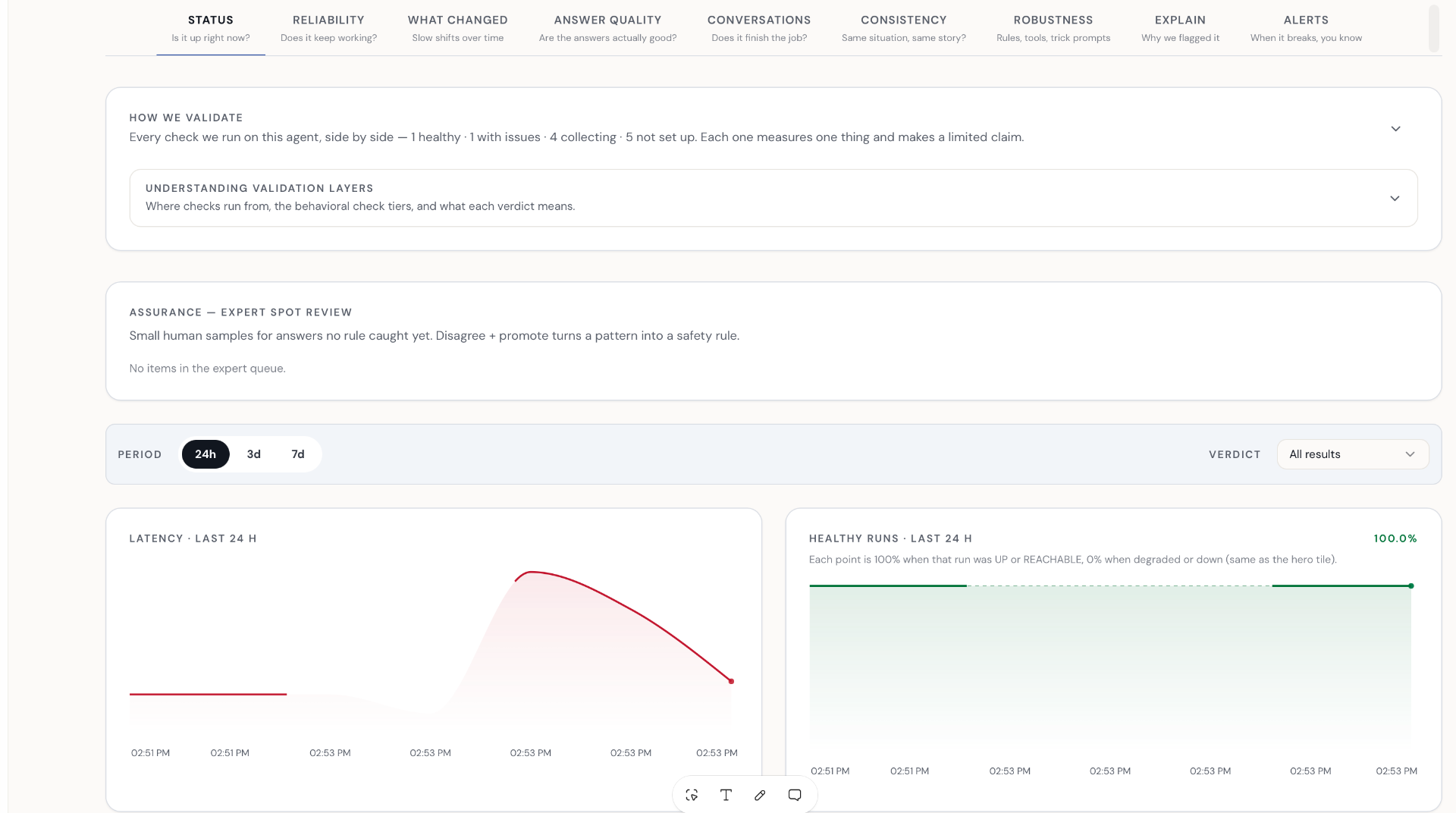
Reachability. Controlled validate traffic from 2,500+ residential devices across 70 countries measures whether users can open the agent the way they do — past CDN, WAF, and bot walls that treat datacenter synthetics differently. Monitoring asks if it is healthy right now; Reliability asks if it keeps working over time. Multi-geo is observer vantage for access and last-mile latency. It does not change agent tool egress or localize answers by probe IP.
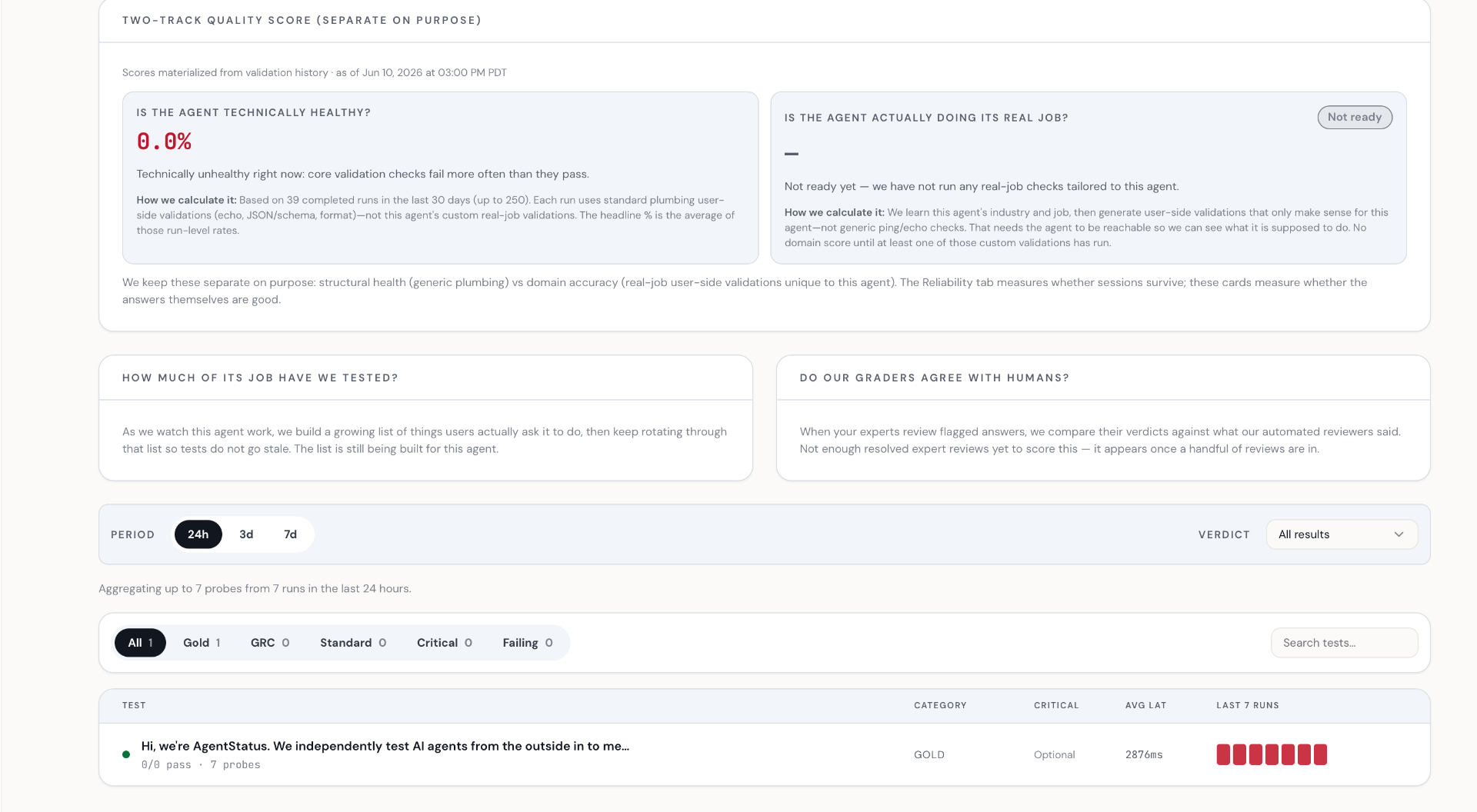
Outcome verification. Once reachable, we verify outcomes: Scenario (did it finish the job?), Compositional (do the pieces hold together?), Safety (must-not-say / policy / attacks), Stability (same ask, same story?). Consistency and Drift track what changed. Job anchors and side-effects where they exist — not prose matching. Optional sample review is corroboration only; stably wrong still needs a domain expert.
Independent third-party validation is two separate jobs

Reachability
Outcome
Can we talk to it?
Residential observers take the inbound path customers take — past CDN, WAF, and bot walls that treat datacenter synthetics differently. Monitoring asks: is it healthy right now? Reliability asks: does it keep working over time? “Up” means reachable from home networks, not from AWS.
Outcome verification
Outcome
Did it do the right thing?
Reachable and wrong is still broken. Scenario — did it finish the job? Compositional — do the pieces hold together? Safety — must-not-say, policy, attack probes. Stability — same ask, same story? Scores: Consistency and Drift. Not prose matching. Optional sample review is corroboration only.
Where we fit
We sit beside the platform. We do not replace it.
Beta-time accuracy vs production drift
Human-in-the-loop vs continuous evidence
Global execution footprint
Partner-friendly integration posture
The split
How the work divides
Your platform
- • hx Renew pricing platform
- • Ingestion / Underwriting / Actuarial Agents
- • Triage & Portfolio Intelligence
- • Human-in-the-loop workflows
- • SOC 2 Type 2 / ISO 27001:2022
Outcome
System of record
Dashboards, exports, lifecycle tools, and orchestration remain yours. We do not replace that surface.
AgentStatus
- • Continuous validate traffic
- • Gold libraries & drift detection
- • Multi-turn / multi-agent journeys
- • Real-network execution evidence
- • 2,500+ nodes across 70 countries
Outcome
User-side layer
Reachability (Monitoring / Reliability) from residential networks, then outcome verification once reached — Scenario, Compositional, Safety, Stability; Consistency and Drift scores. Not prose matching.
Proof of scale
Auditable scale metrics
In about two months, we have executed on the order of 18 million validate runs across the network. We also maintain on the order of 6,000 agent records in our system, meaning rows and configurations we track, including evaluation and pipeline agents, not "6,000 paying customers."
We have also caught node operators trying to game the network with datacenter VMs instead of real consumer egress. Detection of adversarial behaviour is built into the product. If helpful, we can share stricter production-only definitions under NDA.
What we are not claiming
We are an independent layer that runs alongside your stack.
We are not a replacement for hx Renew, the Ingestion Agent, the Underwriting Agent, the Actuarial Agent, Triage, or the broader hx AI suite. We are an independent layer that can coexist with them, and where useful, help carriers and MGAs correlate user-side validate outcomes with inside-out agent performance, so actuarial leaders, underwriters, and AI programme managers have continuous evidence the deployed agents are still behaving the way the platform intended.
What we'd like from this conversation
These three asks would move a pilot forward.
Validate the fit
As Banyan Risk's full agentic suite deployment matures and Aviva's Actuarial Agent beta scales, where do hx's customers want independent assurance, and where does hx prefer everything native to the platform?
A practical next step
A sandbox surface we can validate with gold prompts representative of an underwriting workflow (Ingestion Agent submission extraction, Triage prioritisation, Actuarial Agent model-build assistance), so hx's agentic suite and AgentStatus drift detection tell one story together.
Partner path
If there is a partner path, we'd like to understand supported integration patterns for carriers, MGAs, and reinsurers operating across the Lloyd's Market, EMEA, and North America, particularly through hx's strategic alliances with Guidewire, Moody's, and Duck Creek.
hyperexponential × AgentStatus.
hyperexponential helps carriers and MGAs build and operate AI-native pricing platforms moving tens of billions in premium. AgentStatus helps those same teams prove, continuously, that the deployed agents behave the way actuarial, regulators, and customers require, globally, with evidence that holds up under scrutiny.
Contact·dulra@carmel.so·roman@carmel.so
Metrics are stated with explicit definitions: validate runs are scheduled executions over ~two months; agent records are database rows, not revenue customers. Public hyperexponential references above reflect public product pages, the Banyan Risk announcement (March 2026), the Aviva AI beta announcement, the Triage launch (September 2025), the hx AI launch, and partner disclosures as of the date of this note.