AgentStatus × Genesys
User-side monitoring for Genesys Cloud AI and the customer deployments running on it.
We ran a short-period validation sweep on one Genesys-powered customer-facing deployment to ground the conversation in real findings. The platform itself works fine. What we found inside the deployment is the kind of pattern Genesys' own monitoring architecturally can't surface, and the kind we'd surface across AppFoundry customers at scale.
What we ran
What we ran.
Over a short period, we sent realistic customer-style chat sessions to one Genesys Cloud Web Messaging deployment from real residential devices in the customer's region. Each session was multi-turn, the same way a real customer asks one question, then a follow-up, then another, not a one-shot "is the widget loading?" validation.
118 sessions. 11 validations per session. One anonymized Genesys-powered customer surface. Public-sector vertical.
What AgentStatus is
Finding - the platform is up. The customer experience isn't.
The headline: the chat widget connects 98% of the time. Real conversations work 5% of the time.

Your platform
- • Widget online - 98%
- • WebSocket connection success - 98%
- • Avg response time - under 2s when working
- • No transport errors most of the day
Outcome
System of record
Dashboards, exports, lifecycle tools, and orchestration remain yours. We do not replace that surface.
AgentStatus
- • Multi-turn sessions degraded - 92%
- • Fully healthy sessions - 5%
- • Silent turns inside live sessions - frequent
- • Wrong-topic answers - 78 of 118 runs
Outcome
User-side layer
Reachability (Monitoring / Reliability) from residential networks, then outcome verification once reached — Scenario, Compositional, Safety, Stability; Consistency and Drift scores. Not prose matching.
The dominant failure mode is what we're calling context bleed. A customer asks about reporting a power outage. The bot answers about payment deferral, content from an earlier menu state that didn't reset. The session is technically alive. The transport is fine. The answer is just wrong.
This is the failure mode platform-level monitoring doesn't catch. Genesys Cloud sees: connection established, message exchanged, no transport error. AgentStatus sees: customer asked X, bot answered about Y, customer would now be more confused than before they started chatting.
The deployment we monitored is publicly accessible. We anonymized it in this brief. Name available to Genesys under mutual confidentiality.
Independent third-party validation is two separate jobs
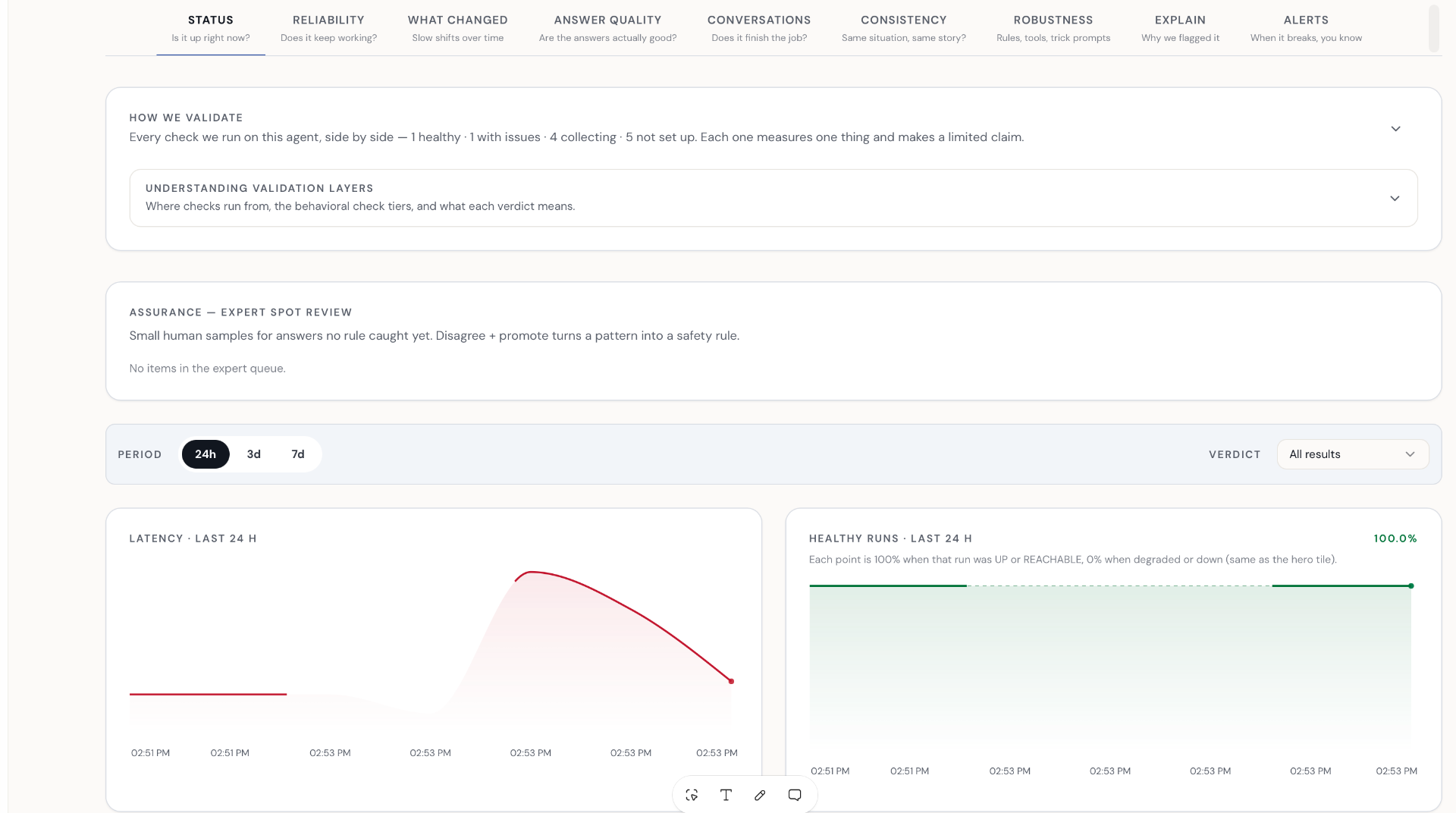
Reachability
Outcome
Can we talk to it?
Residential observers take the inbound path customers take — past CDN, WAF, and bot walls that treat datacenter synthetics differently. Monitoring asks: is it healthy right now? Reliability asks: does it keep working over time? “Up” means reachable from home networks, not from AWS.
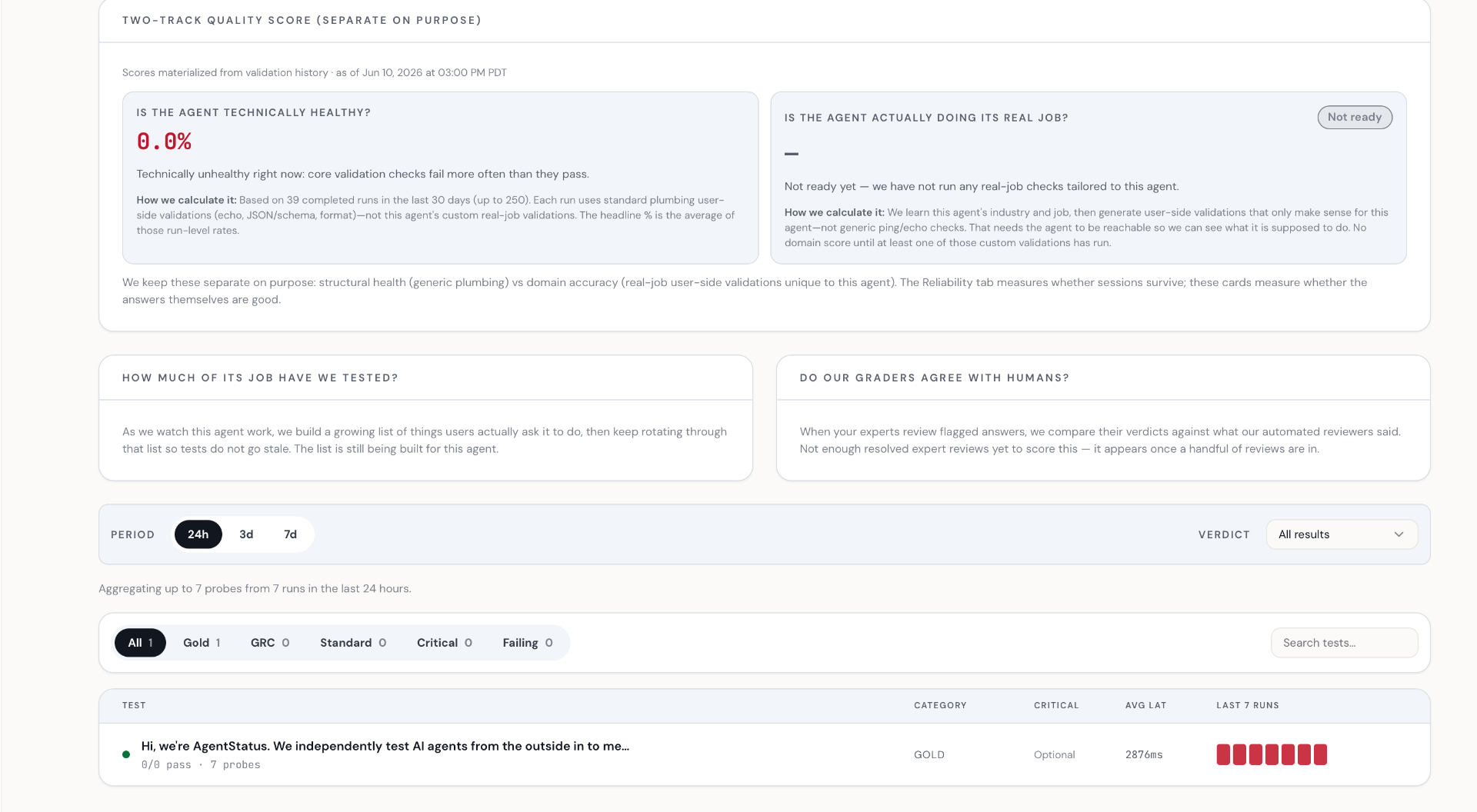
Outcome verification
Outcome
Did it do the right thing?
Reachable and wrong is still broken. Scenario — did it finish the job? Compositional — do the pieces hold together? Safety — must-not-say, policy, attack probes. Stability — same ask, same story? Scores: Consistency and Drift. Not prose matching. Optional sample review is corroboration only.
Where we fit
We sit beside the platform. We do not replace it.
Why one deployment matters
The right question
Direct monitoring layer for Genesys Cloud AI
ISV partner inside AppFoundry
The split
How the work divides
Your platform
- • Genesys Cloud platform health
- • Empathy AI, Agent Copilot, Predictive Engagement
- • Internal QA & simulation
- • Transport, connection, latency metrics
- • AppFoundry ecosystem
Outcome
System of record
Dashboards, exports, lifecycle tools, and orchestration remain yours. We do not replace that surface.
AgentStatus
- • Multi-turn session-quality evidence
- • Gold prompts + context-bleed detection
- • Real residential devices in customer region
- • Wrong-topic & silent-turn surfacing
- • Audit-ready exports for CISO sign-off
Outcome
User-side layer
Reachability (Monitoring / Reliability) from residential networks, then outcome verification once reached — Scenario, Compositional, Safety, Stability; Consistency and Drift scores. Not prose matching.
Proof of scale
Auditable scale metrics
Most enterprise Genesys deployments will eventually want both layers, direct monitoring on Genesys Cloud AI, and AppFoundry-shaped monitoring on the deployments running on top of it.
In the short-period window on this one Genesys-powered surface we observed 118 multi-turn sessions × 11 validations, with widget connectivity at 98% and fully-healthy session rate at 5%. 78 of 118 runs produced a wrong-topic answer consistent with context bleed.
What we are not claiming
We are an independent layer that runs alongside your stack.
This is a short-period demonstration on one anonymized Genesys-powered customer surface, showing the class of finding user-side surfaces that platform monitoring doesn't.
This isn't a statement about Genesys Cloud reliability, the platform itself performed well. The findings are about the customer deployment running on top of it.
A structured pilot across a small cohort of Genesys customers (sandbox or live-with-consent) would tell us whether the context-bleed and session-quality patterns we found are common across AppFoundry, vertical-specific, or specific to this one deployment. Our hypothesis: common.
What we'd like from this conversation
These three asks would move a pilot forward.
A 2-week structured pilot
Direct on Genesys Cloud AI for the Motion 1 conversation, AppFoundry-shaped on 3-5 customer deployments for the Motion 2 conversation, or both in parallel.
Aligned scope upfront
Gold prompts, domain definitions, rate limits, all agreed before validations start. Weekly reports to Genesys' platform and AppFoundry teams.
Honest finding at the end
Did user-side surface things internal monitoring didn't? We share what we saw, both ways.
Genesys × AgentStatus.
The platform is up. Customer experience under multi-turn load is a different question. We'd love to hop on a call and walk through what two weeks of user-side monitoring looks like across a small Genesys customer cohort, direct, AppFoundry, or both.
Contact·dulra@carmel.so·roman@carmel.so
This brief reflects monitoring data from a short window on one publicly-reachable Genesys-powered customer-facing chat surface. Validations ran from real residential devices in the customer's region at conservative rate limits; no tenant data was collected beyond verdict metadata, latency aggregates, gold-prompt outcomes, and short response previews. Customer name anonymized in this brief; available to Genesys under mutual confidentiality. AgentStatus is independent user-side production monitoring for AI agents and is not affiliated with Genesys.