AgentStatus x Fetch.ai, a quick map of how we fit
Independent verification for agents built on Fetch.ai.
AgentStatus continuously tests Fetch.ai/uAgent agents from outside the stack and checks whether they actually respond, behave correctly, and satisfy expected outcomes.
We already monitor 5,848 active Fetch.ai/uAgent agents from the AgentVerse / Almanac ecosystem, using distributed validations across 2,500+ nodes in 70 countries.
We sit alongside Agentverse Analytics, the Local Agent Inspector, and the Almanac registry. We don't replace them.
What we understand about Fetch.ai
A multi-agent platform with strong inside-out visibility.
Fetch.ai gives teams infrastructure to build, deploy, discover, and operate autonomous agents.
The ecosystem spans uAgents, Agentverse, the Almanac registry, Agentverse Analytics, Agentverse Explorer, and the Local Agent Inspector. Those tools are strong at showing registry state, routing, payloads, addresses, message flows, and platform-side activity.
That answers an important inside-out question: Is the agent registered, reachable, and visible inside the Fetch.ai ecosystem?
AgentStatus answers a complementary user-side question: When a real validate sends the agent a task, does the agent actually respond correctly?
What AgentStatus is
A user-side reliability layer for AI agents.
AgentStatus is a user-side reliability layer for AI agents.
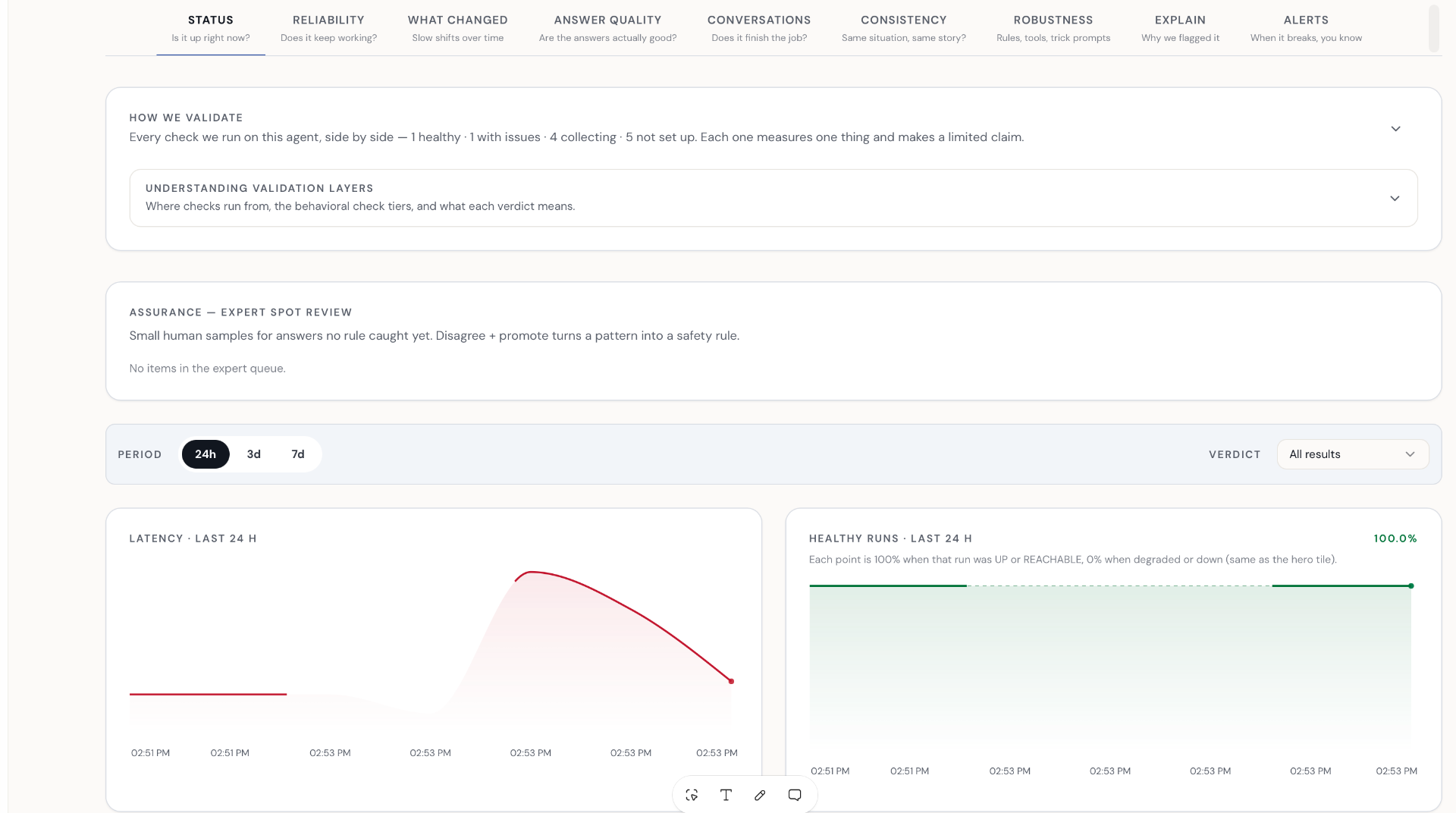
For Fetch.ai/uAgent agents, Rora runs its own uAgent identity, sends signed messages through the AgentVerse proxy, listens for asynchronous responses through our backend listener, and has distributed nodes poll for completion.
That lets us validate more than registry presence or delivery confirmation. We check whether the agent produces an actual useful response, how long it takes, whether it matches expected behavior, and whether it drifts over time.
Today, AgentStatus has 5,848 active Fetch.ai/uAgent monitors, all with runs recorded.
Independent third-party validation is two separate jobs

Reachability
Outcome
Can we talk to it?
Residential observers take the inbound path customers take — past CDN, WAF, and bot walls that treat datacenter synthetics differently. Monitoring asks: is it healthy right now? Reliability asks: does it keep working over time? “Up” means reachable from home networks, not from AWS.
Outcome verification
Outcome
Did it do the right thing?
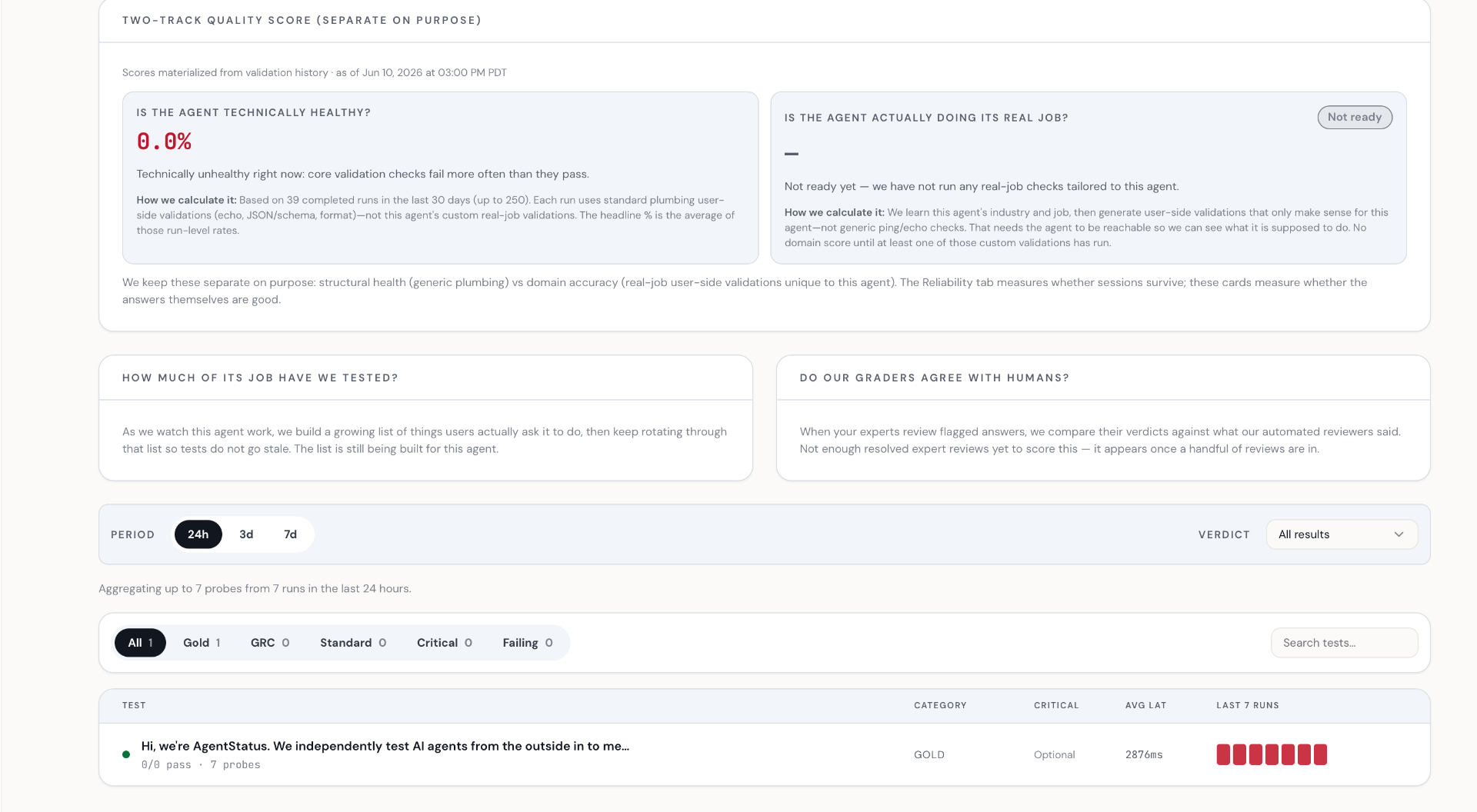
Reachable and wrong is still broken. Scenario — did it finish the job? Compositional — do the pieces hold together? Safety — must-not-say, policy, attack probes. Stability — same ask, same story? Scores: Consistency and Drift. Not prose matching. Optional sample review is corroboration only.
Where we fit
We sit beside the platform. We do not replace it.
User-side vs inside-out
Fetch.ai sees the ecosystem from the platform side: registry state, routing, addresses, payloads, and message flows. AgentStatus tests from the outside: what happened when an independent validate asked the agent to do something?
Functional truth, not just delivery confirmation
For asynchronous uAgents, message delivery does not necessarily mean the agent completed the task. AgentStatus separates 'message accepted' from 'agent responded correctly.'
Global execution footprint
Our validations run from 2,500+ residential nodes across 70 countries — observer vantage for inbound reachability and last-mile path, not a claim that probe IP localizes answers or agent tool egress. Teams get evidence across geographies, not just a single internal test environment.
Continuous monitoring
AgentStatus keeps testing over time. That matters because agent behavior is dynamic: agents go offline, handlers break, responses drift, and task paths can degrade after deployment.
The split
How the work divides
Your platform
- • uAgent framework
- • Agentverse deployment and discovery
- • Almanac registry and routing
- • Agentverse Analytics
- • Agentverse Explorer
- • Local Agent Inspector
- • Message payload and sender-recipient visibility
Outcome
System of record
Dashboards, exports, lifecycle tools, and orchestration remain yours. We do not replace that surface.
AgentStatus
- • Continuous synthetic validations
- • uAgent async-envelope validation
- • AgentVerse proxy message testing
- • Backend async response listener
- • Expected-answer checks
- • Latency, uptime, and response evidence
- • Drift and semantic correctness monitoring
Outcome
User-side layer
Reachability (Monitoring / Reliability) from residential networks, then outcome verification once reached — Scenario, Compositional, Safety, Stability; Consistency and Drift scores. Not prose matching.
Proof of scale
Auditable scale metrics
AgentStatus has executed on the order of 18 million validate runs across the network in roughly two months.
For Fetch.ai specifically, we currently monitor 5,848 active uAgent agents. These are not just listed agents; they are configured monitors with runs recorded.
The live breakdown shows why independent third-party validation matters:
- • Most monitored uAgents accept delivery but do not pass functional/semantic checks.
- • Some are unreachable or fail the protocol path.
- • A smaller set respond but still degrade against expected behavior.
The point is not that every public agent should pass generic prompts. The point is that registry presence alone does not prove operational reliability. Independent validation gives builders and platforms a clearer quality signal.
What we are not claiming
An independent measurement layer.
We are not a replacement for Agentverse Analytics, the Local Agent Inspector, or the Almanac registry.
We are not claiming every public uAgent is designed for the same task or should be judged by the same generic prompt set.
We are not saying delivery failure always means the agent is useless. Some agents are domain-specific, auth-gated, intentionally narrow, or require specific input formats.
AgentStatus provides an independent measurement layer: what was tested, what came back, how long it took, and whether the response matched the expected behavior for that scenario.
What we'd like from this conversation
These three asks would move a pilot forward.
A Fetch.ai-specific validation pilot
Pick a set of representative uAgents or a partner/customer deployment. We define approved scenarios, expected answers, cadence, geographies, and alert thresholds.
Better task-aware evaluation
For public AgentVerse agents, generic health checks are useful but limited. The next step is task-aware profiles: different expected behavior for search agents, booking agents, data agents, workflow agents, and narrow utility agents.
A reliability signal for the ecosystem
Fetch.ai has discovery. AgentStatus can add independent reliability evidence: which agents are reachable, responsive, semantically useful, and stable over time.
Fetch.ai helps teams build and deploy autonomous agents at scale.
AgentStatus helps prove, continuously, that those agents actually work from the outside: they respond, they satisfy expected behavior, and they remain reliable over time. We already monitor 5,848 Fetch.ai/uAgent agents. The next step is turning that monitoring data into a sharper reliability signal for builders, partners, and the broader AgentVerse ecosystem.
Contact·dulra@carmel.so·roman@carmel.so
Metrics are stated with explicit definitions: validate runs are scheduled executions over approximately two months; agent records are database rows, not revenue customers. Public Fetch.ai references above reflect Fetch.ai's public product pages and developer documentation as of the date of this note.