AgentStatus × Boost.ai
Independent commitment-boundary observability, with 2,286 aggregate snapshots already on the wire across active Boost tenants.
AgentStatus is how platform and GTM teams prove behavior in the wild: continuous controlled validate traffic, gold-based expectations, drift-aware alerting, and optional adversarial conformance, run from 2,500+ residential nodes across 70 countries. We sit next to Boost-powered customer assistants on the same public chat paths users hit. We do not replace Boost's NLU stack, orchestration, or enterprise workflow layer. We add the independent layer that observes, records, and surfaces commitment behavior over time.
What we understand about Boost.ai
Enterprise conversational AI succeeds or fails on what it commits to.
Boost.ai's footprint is enterprise conversational automation in policy-sensitive, regulation-adjacent domains, telecom support, financial services, public-sector front lines. In production, the dangerous failure mode is rarely outright unavailability. It is the assistant that confidently asserts a numeric value, a policy, or a commitment that fails gold/contract or consistency checks, without breaking content policy, without tripping moderation, without throwing an error.
Detection-based defenses (moderation, hallucination classifiers, generic global guardrails) reduce some failure modes but do not reliably prevent factually incorrect commitments under semantic pressure. The empirical picture is increasingly consistent: commitment-stage controls are the decisive lever, and their effectiveness depends on continuous evidence about how the assistant actually behaves once deployed.
For Boost-powered deployments, the operationally critical question is not whether a single eval suite passed at launch. It is whether commitment behavior holds week over week, across regions, languages, and traffic shape, and whether there is independent evidence to defend that claim in front of risk, security, and procurement reviewers.
What AgentStatus is
Continuous, controlled validate traffic against production Boost chat surfaces.
AgentStatus runs scheduled, repeatable validations against customer-visible Boost endpoints, including multi-turn and streaming-style paths where enabled, classifies outcomes into defensible verdict tiers, and retains evidence-grade aggregates and previews for post-mortems.
Where enabled, we run conformance-style stress validations including semantic, hypothetical, and boundary-pressure scenarios, the failure surface where assistants drift from real terms toward whatever the user seems to want them to confirm. We retain structured pass/fail outcomes per validate, so concentration patterns surface instead of getting averaged away.
For enterprise customer support AI, the expensive failure mode is rarely hard-down. It is silent commitment drift, boundary misses, grounding decay under semantic reframing, latency-driven SLA failure, and access variance by observer path — visible only from outside the assistant's own perimeter, on the same public inbound paths users actually take.
Independent third-party validation is two separate jobs

Reachability
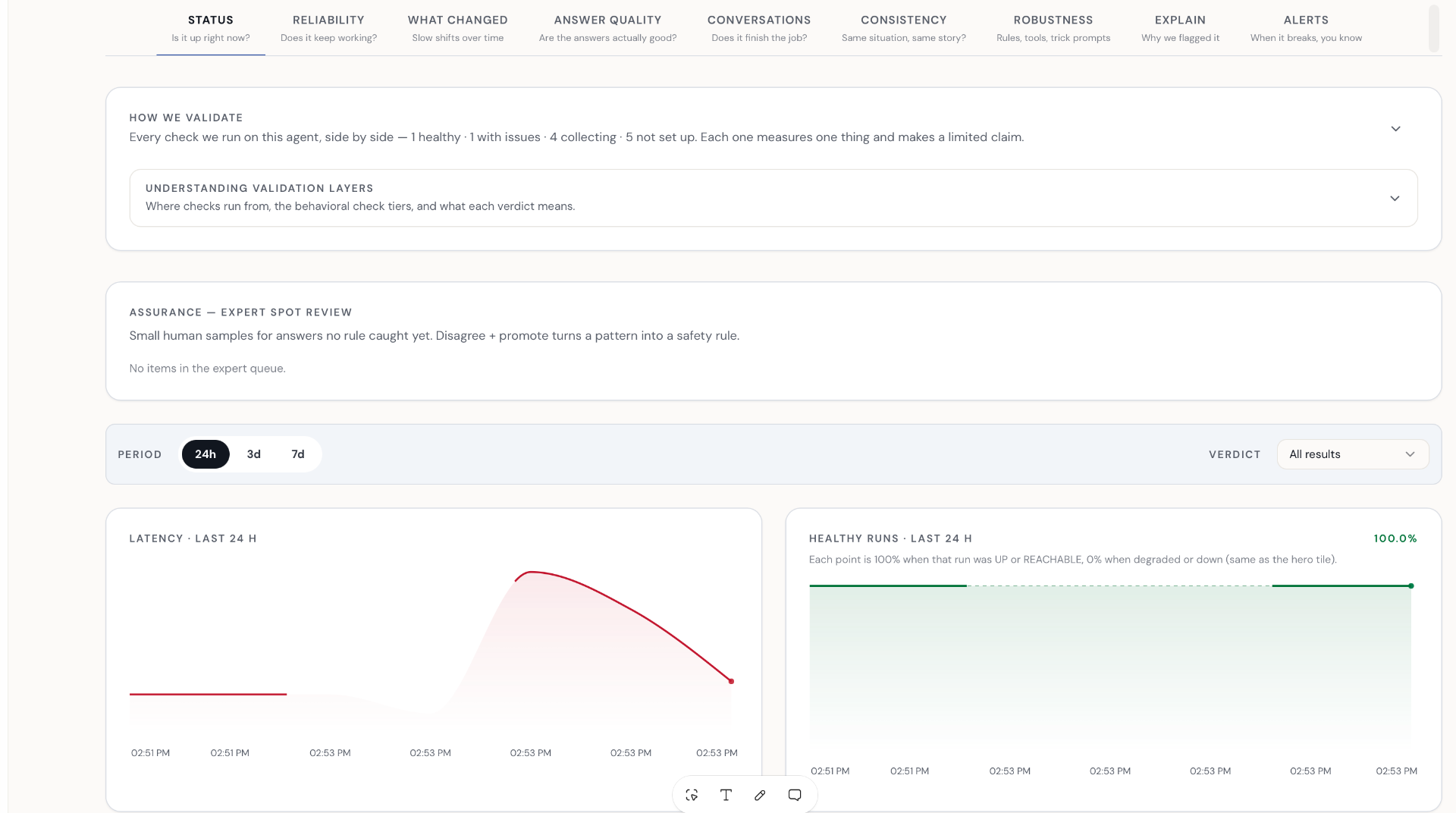
Outcome
Can we talk to it?
Residential observers take the inbound path customers take — past CDN, WAF, and bot walls that treat datacenter synthetics differently. Monitoring asks: is it healthy right now? Reliability asks: does it keep working over time? “Up” means reachable from home networks, not from AWS.
Outcome verification
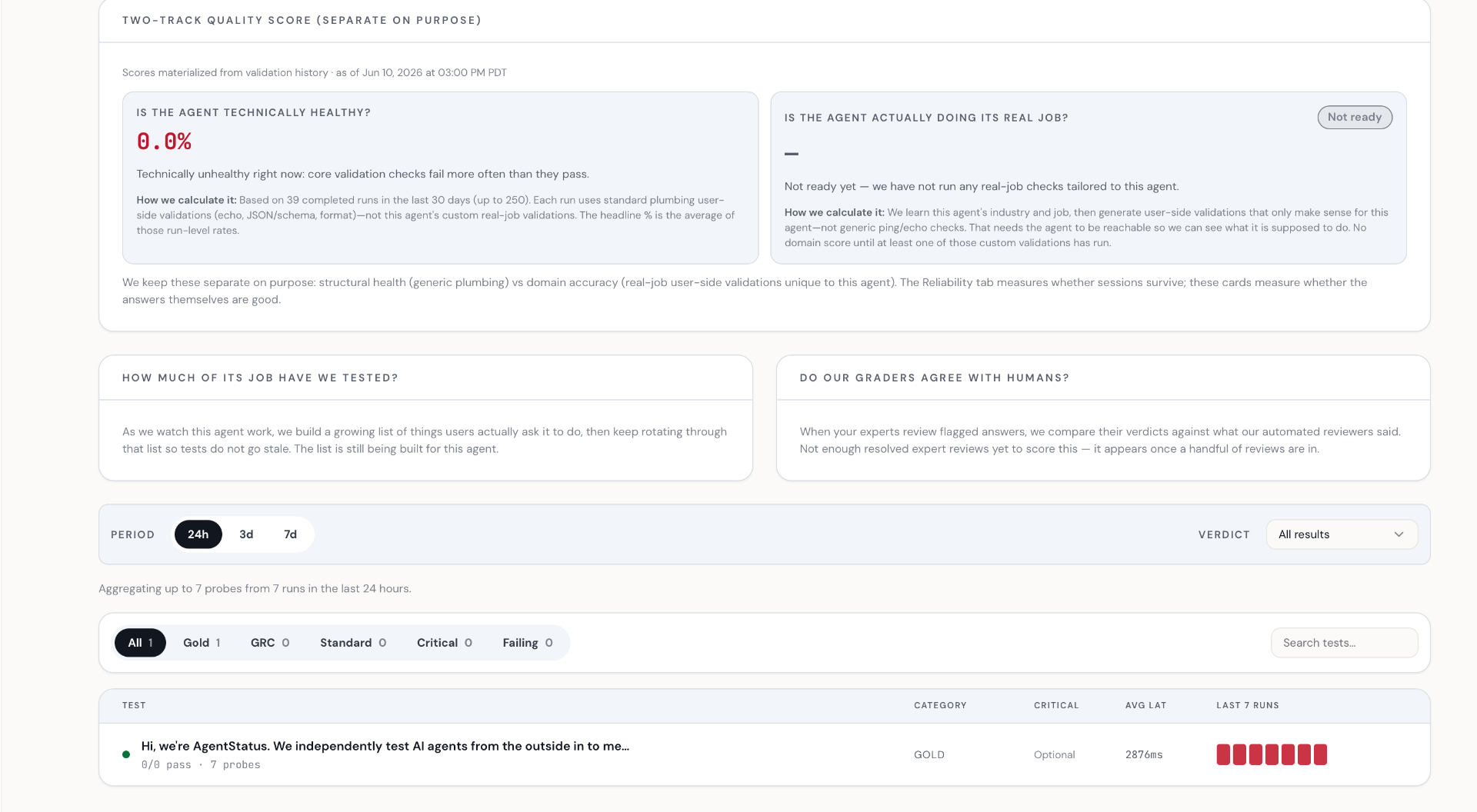
Outcome
Did it do the right thing?
Reachable and wrong is still broken. Scenario — did it finish the job? Compositional — do the pieces hold together? Safety — must-not-say, policy, attack probes. Stability — same ask, same story? Scores: Consistency and Drift. Not prose matching. Optional sample review is corroboration only.
Where we fit
We sit beside the platform. We do not replace it.
Platform delivery vs commitment observability
Point-in-time evals vs sustained production telemetry
Global execution footprint with concentration analysis
Partner-friendly posture
The split
How the work divides
Your platform
- • Enterprise conversational AI platform
- • Dialog orchestration, NLU, routing
- • Tenant-specific configuration
- • Internal analytics & support outcomes
- • Platform scale & roadmap
Outcome
System of record
Dashboards, exports, lifecycle tools, and orchestration remain yours. We do not replace that surface.
AgentStatus
- • Scheduled validate traffic on public paths
- • Gold libraries + drift signals + slot-level analysis
- • Multi-turn / streaming paths where enabled
- • Verdict-tier evidence + commitment-boundary observations
- • 2,500+ residential nodes across 70 countries
Outcome
User-side layer
Reachability (Monitoring / Reliability) from residential networks, then outcome verification once reached — Scenario, Compositional, Safety, Stability; Consistency and Drift scores. Not prose matching.
Proof of scale
Auditable scale metrics
A. Posture first
How we operated: monitoring targeted publicly reachable, customer-visible Boost chat surfaces with conservative rate limits and no attempt to bypass authentication barriers. We did not collect tenant back-office data. Retained artifacts are verdict metadata, latency and pass-rate aggregates, short response previews, and structured gold outcomes, enough to prove behavior, not reconstruct customer records.
B. What we measured (Boost-only, time-bounded window)
Across two active Boost monitors (telecom + financial), we observed 2,286 aggregate rora_results snapshots: 1,358 UP, 927 DEGRADED, 1 DOWN.
By tenant:
- A1 Slovenia (telecom_support): 1,305 rows, 681 UP / 623 DEGRADED / 1 DOWN
- MSUFCU (financial_support): 981 rows, 677 UP / 304 DEGRADED / 0 DOWN
C. Honest mix and concentration signal
The degradation tail is not random; it is structured, and the structure is the most useful part of this evidence.
The dominant degradation class is latency SLA (ttfb_sla): 340 A1 rows and 292 MSUFCU rows. That is a transport-shape signal, first-byte latency under real consumer-network conditions, and it is exactly the kind of signal that internal monitoring inside the cloud perimeter does not see, because internal monitoring is, by construction, inside the perimeter.
The semantic tail is concentrated, not diffuse. A1 shows 246 gold_fail rows, of which 227 are no_patterns_found failures on a single boundary-awareness validate (slot 6). That is not broad capability collapse. That is a targeted boundary-control issue at one validate slot, the kind of finding that becomes a one-line remediation conversation rather than a six-month rearchitecture.
This concentration signal is the entire reason slot-level evidence matters. An aggregate "82% pass" number would have hidden it. A verdict tier without validate-slot decomposition would have hidden it. The boundary control issue is real, but it is small, specific, and fixable, and that is only legible because the evidence layer keeps the resolution.
D. Definitions
A rora_results row is one aggregate monitoring snapshot for a configuration. It is not a customer count, not a revenue figure, not an SLA claim. Verdicts are configuration-level outcomes from the underlying validations that contribute to the snapshot. DEGRADED means transport succeeded but at least one configured check failed (ttfb_sla or a gold expectation). gold_fail means a validate ran successfully but the response did not satisfy the configured expectation for that validate slot. These metrics are not Boost SLAs, ARR, or customer counts unless separately agreed in writing. We are deliberate about these definitions because in this category, vague metrics are how trust dies.
What we are not claiming
We are an independent layer that runs alongside your stack.
We are not a replacement for Boost's platform, NLU stack, orchestration, or customer-specific policy logic. We are the independent observation layer producing repeatable, externally executed evidence about how customer-visible assistants behave over time, and where commitment behavior begins to drift.
Detection layers (moderation, hallucination classifiers, generic guardrails) sit upstream of us in the typical defensive stack. We sit downstream, observing what was actually committed to, against ground truth, on real consumer paths. Detection and observation are complementary; neither is a substitute for the other.
What we'd like from this conversation
These three asks would move a pilot forward.
Validate the fit
Where would Boost want independent commitment-boundary evidence surfaced: partner GTM, enterprise security review, joint customer success, or platform-internal observability? And where should evidence remain native to Boost's own analytics surface?
Practical next step
A small named cohort, sandbox or live-with-consent, where we align on gold prompts (especially boundary-pressure validations), latency expectations, and rate limits. Then we lock a shared definition of "healthy" both teams can defend in front of an enterprise customer's risk function.
Partner path
If there is a path to formal collaboration, we should align early on credentialed monitoring, tenant scoping, and customer approval controls. Those three decisions determine whether user-side evidence is procurement-grade or roadmap noise.
Boost.ai × AgentStatus.
Boost.ai helps enterprises deploy and scale conversational AI in regulated, customer-facing production. AgentStatus helps those same enterprises prove, continuously, that commitment behavior remains correct under real-world network, latency, and semantic pressure, with evidence that holds up outside a demo environment, and that surfaces the small, fixable findings before they become the large, expensive ones.
Contact·dulra@carmel.so·roman@carmel.so
Figures reflect a time-bounded production monitoring window on two active Boost HTTP monitors (A1 Slovenia / telecom_support and MSUFCU / financial_support). Metrics are stated with explicit definitions: a rora_results row is one aggregate snapshot for a monitored configuration; underlying validations contribute to verdict, pass-rate, and latency aggregates; DEGRADED means transport succeeded but at least one configured check failed; gold_fail and no_patterns_found denote validate-level expectation failures. These metrics are not revenue, customer counts, or Boost-specific SLAs unless separately agreed in writing.