
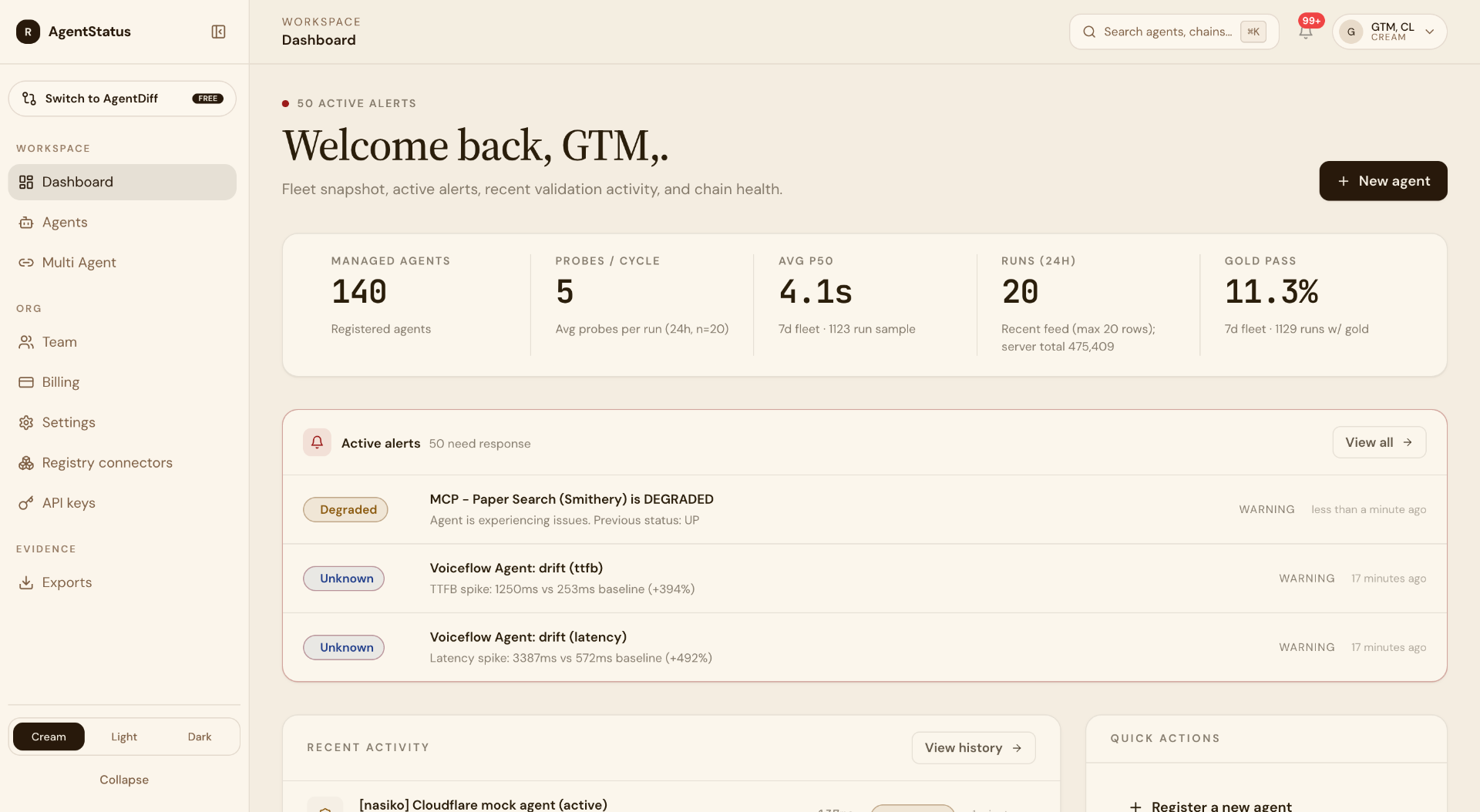
Alerts engineers can actually act on.
Every alert links to the validation that triggered it, the full request and response, the affected regions, and a recommended owner.
User-side validation isn't theory.We've been running it.
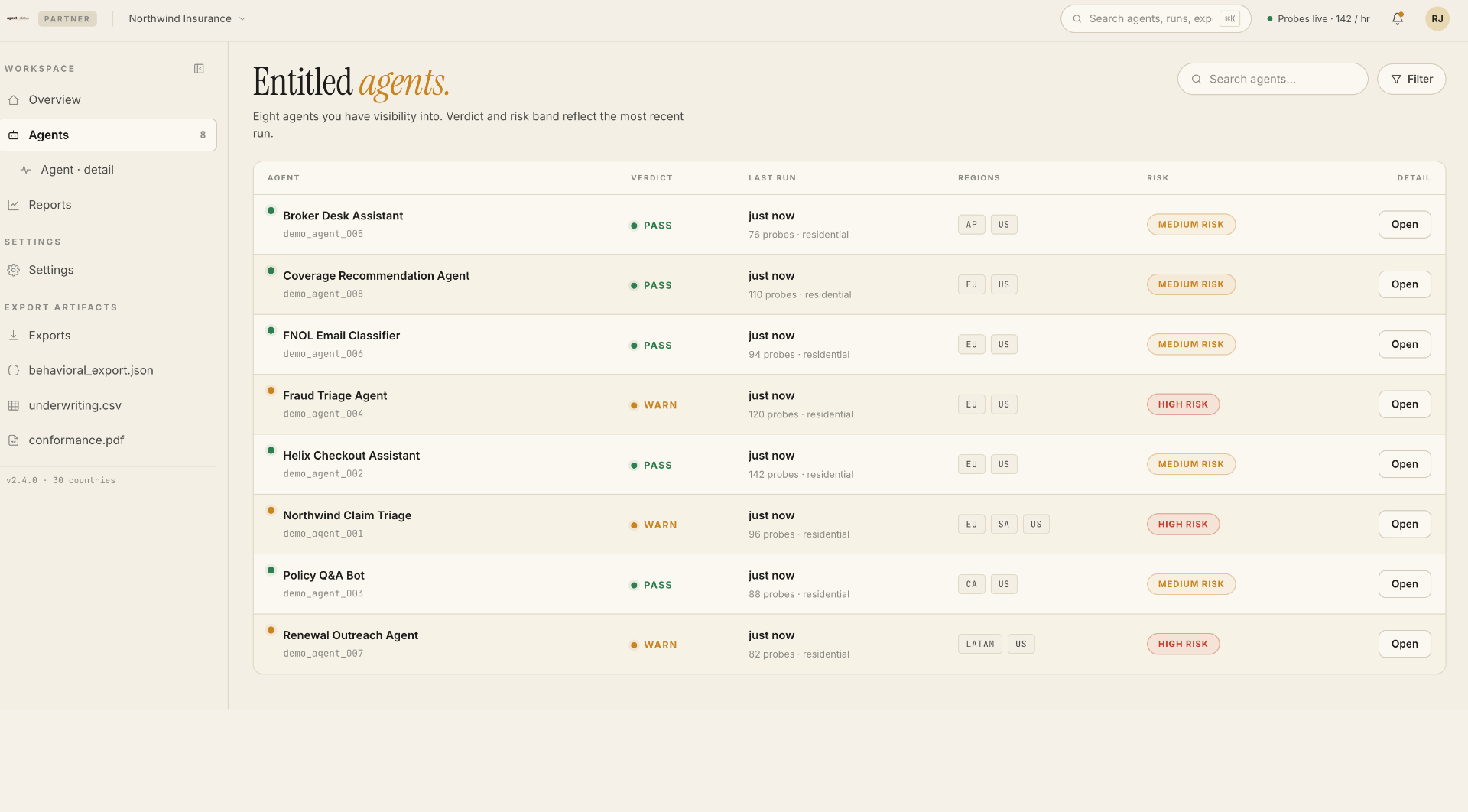
Agents continuously monitored across the global network.
Independent third-party checks run from real residential devices.
Countries covered on real home ISPs.
The failure modes your current stack misses
Your first signal is a customer ticket.
By the time it lands in support, hundreds of users saw the bad answer.
The alert says 'something is wrong'. Engineering has no replay.
Without the actual response payload, the on-call has nothing to debug.
Noisy alerts get ignored.
A flaky region pages the team three times a day. Real alerts drown.
Replay
Every alert ships with the validation that caused it.
Open the alert, see the prompt, the response, the region, the verdict, and a one-click replay.
- Full request and response
- Region and exit attribution
- One-click replay

Smart routing
Right team, right channel, every time.
Per-agent routing rules: drift to model team, latency to SRE, conformance to compliance. PagerDuty, Slack, or webhook.
- Per-agent destinations
- Severity-aware routing
- On-call schedules
Noise control
Multi-window confirmation kills flap.
Alerts confirm across windows before firing. Flaky regions can be quarantined without losing the signal.
- Multi-window confirmation
- Region quarantine
- Snooze with reason
From first validation to signed report in two weeks
Connect
Point Agent Status at the user-facing surface of your agent. No SDK, no instrumentation. Average setup is under five minutes.
Watch
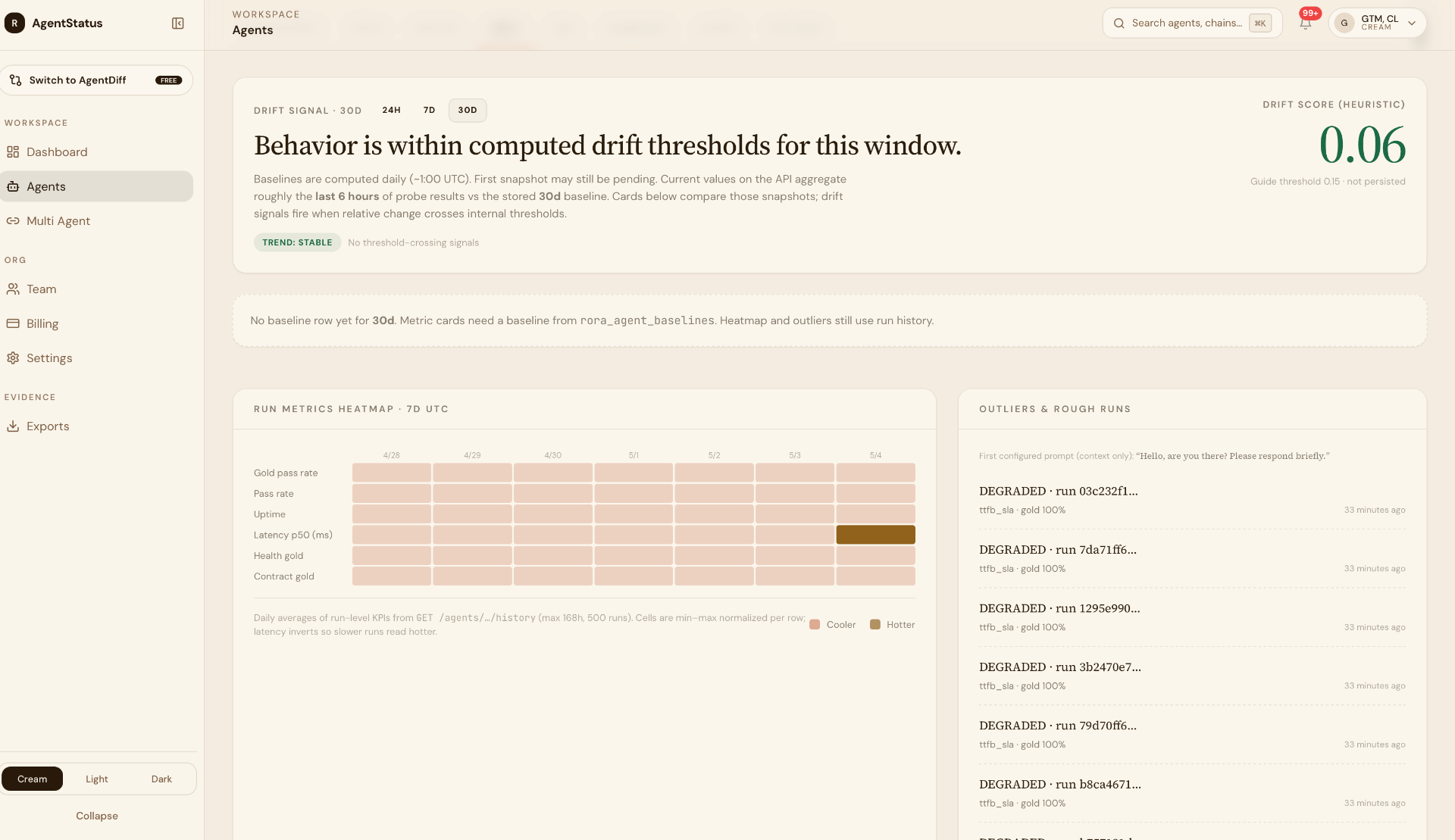
Live verdicts stream in from every region you serve. Drift and latency alerts route to PagerDuty or Slack, with a signed report on every run.
Frequently asked
| Question | Answer |
|---|---|
| Does it integrate with PagerDuty? | Yes. Native PagerDuty integration with severity mapping. |
| Can we customize alert payloads? | Yes. Webhook payloads are templatable. |
| How do we silence during maintenance? | Maintenance windows are per agent and per region. |
| Do alerts include a recommended owner? | Yes. Owner inference from agent tags and routing rules. |